Articles
Posted on February 27, 2026
Canada’s Economy Declined by 0.6% in Q4, Taking Overall Real GDP Growth to 1.7% in 2025.
The Canadian Economy Shrinks by 0.6% in Q4, Owing to a Decline in Business Inventories
Statistics Canada reported this morning that the Canadian economy contracted by 0.6% at a seasonally adjusted annual rate, a significant reversal from the 2.4% expansion posted in Q3. The weaker growth rate reflected a steep decline in business inventories, which was partially offset by increases in household spending, exports, and government capital spending.
Economists surveyed by Bloomberg were expecting a 0.2% annualized decline over the last three months of 2025, while the Bank of Canada projected flat growth.
As US tariffs weighed on Canadian exports for much of the year, real GDP increased by 1.7% in 2025, marking the slowest annual growth since the economy contracted in 2020 owing to the COVID pandemic. Lower exports, particularly to the United States, were the main contributor to the slower rise in GDP in 2025.
A preliminary estimate suggests real GDP remained unchanged in January, after increasing by 0.2% in December, slightly stronger than economists’ estimate of 0.1%.
Exports rose 1.5% in the fourth quarter, after increasing 0.9% in the third quarter. The growth in the fourth quarter was led by higher exports of unwrought gold and of unwrought aluminum and aluminum alloys. Despite the increases in the latter half of the year, exports fell 1.7% in 2025, as shipments to the United States did not fully recover following the drop in the second quarter.
Imports edged up 0.3% in the fourth quarter, as higher imports of computers, clothing and footwear, and metal ores were largely offset by lower imports of pharmaceutical and medicinal products. For the year, imports were down 0.4% in 2025, driven by the 2.9% decline in the third quarter.
% Change in gross domestic product, seasonally adjusted annualized rate
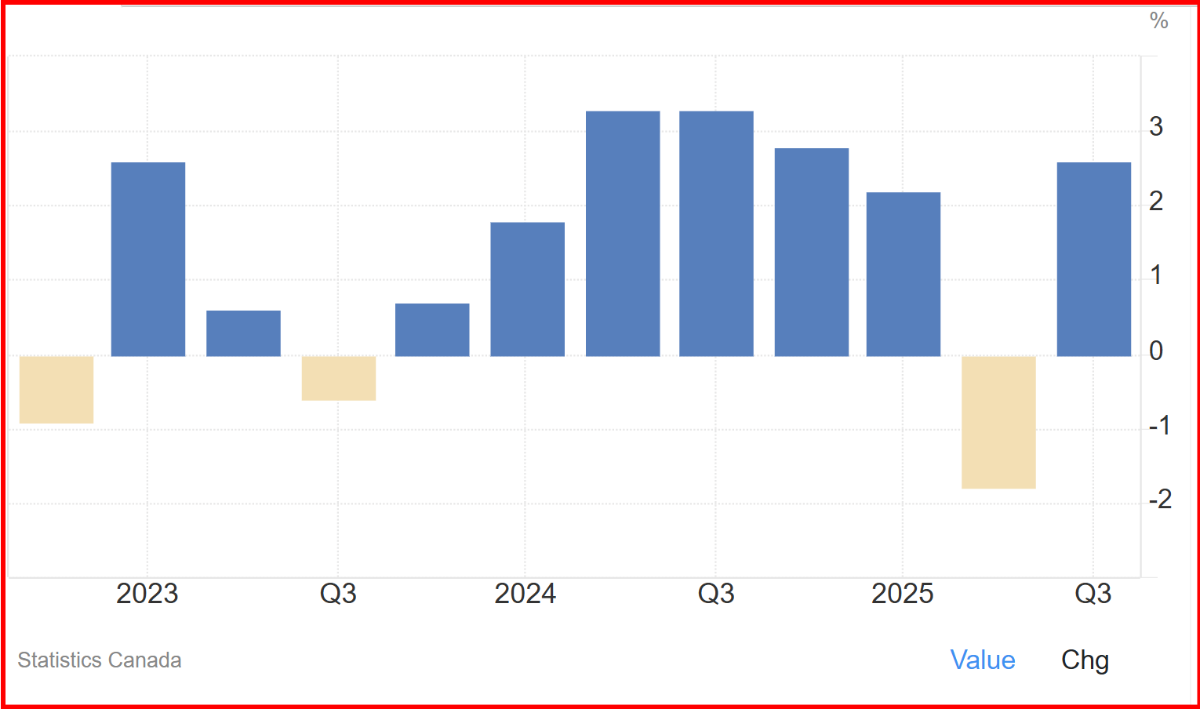
The better-than-expected Q3 gain will not be sustained in Q4, as Statistics Canada’s advance estimate for October showed industrial gross domestic product fell at a -0.3% monthly pace.
The current overnight policy rate of 2.25% remains stimulative, but until the likely outcome of trade negotiations with the US is resolved, Canada’s economy will be on shaky ground. It is unclear whether the Canada-US-Mexico free trade agreement will be extended beyond this year. If not, Canada will be in for a significant trade policy redo as it seeks replacement markets for its exports.
Household spending rose 0.4% in the fourth quarter after declining 0.2% in the third quarter. Higher expenditures on rent and financial services in the fourth quarter were partially offset by lower spending on new passenger vehicles and alcoholic beverages, as overall expenditures on goods declined for a second consecutive quarter.
On an annual basis, household final consumption expenditure was up 2.3% in 2025, keeping pace with the 2.2% growth in each of the previous two years. The rise in 2025 was led by increased household spending on financial services and rent.
Total capital investment rose 0.8% in the fourth quarter, driven by increased government investment in weapons systems. In contrast, business capital investment edged down 0.1% in the fourth quarter, as both residential and non-residential investment decreased. These declines were moderated by increased business investment in machinery and equipment, primarily computers (+19.6%) and intellectual property products, namely software (+0.7%).
Annually, total capital investment increased 1.4% in 2025, led by higher government investment in weapons systems (+45.9%) and engineering structures (+6.7%). Business investment rose 0.3% in 2025, as higher residential construction (+1.0%) and non-residential construction (+1.6%) were largely offset by weaker investment in machinery and equipment (-3.5%). The year 2025 was the third consecutive year in which government capital investment contributed more to GDP growth than business capital expenditures.
Business residential investment declined in the fourth quarter, led by decreased ownership transfer costs (-2.4%), a measure of resale market activity, and lower renovations (-1.3%). New construction (-0.5%) also declined in the fourth quarter due to lower work put in place for single- and apartment units.
Higher business residential investment in 2025 represented the first annual increase since 2021, as increased new construction (+1.0%) and renovations (+2.7%) more than offset the decline in ownership transfer costs (-3.4%).
Bottom Line
While weaker-than-expected Q4 GDP figures might normally trigger an easing move by the Bank of Canada, the Governing Council has made it very clear that it remains concerned about inflation. Tariff uncertainty is especially high now that the Supreme Court has found the Trump administration misused the International Emergency Economic Powers Act (IEEPA) to impose sweeping, open-ended tariffs — striking down the legal foundation for a central pillar of the administration’s trade strategy.
The decision removes the fastest way to impose broad country-level duties, but it does not end the tariff debate. Other statutory authorities remain in play, and businesses and trading partners are left to assess what comes next.
The ruling also lands amid sustained political pressure around affordability, which may shape how aggressively trade tools are redeployed. Even if tariff rates decline, businesses must now assess whether alternative authorities will be used to reimpose them. For the real economy, restoring stability may matter as much as reducing tariffs themselves.