Articles
Posted on June 5, 2026
So Much For Recession, Canada’s May Jobs Report Was A Blockbuster
So Much For Recession Worries, The May Jobs Report For Canada Was A Blockbuster
Canadian employment surged 87,800 in May, the strongest reading since 2024. Today’s Labour Market Survey dispels recession concerns, but leaves the Bank of Canada open to a possible rate hike later this year or next if inflation remains troubling. The Canadian economy continues to show resilience in the face of tariffs and oil price increases.
The headline job gain, combined with a 3,800 rise in the size of the labour force, drove the unemployment rate down three basis points to 6.6%. The jobless rate is still in the 6.5%- 7.0% range seen over the past year. The employment rate rose 0.2 percentage points to 60.7%.
The report’s details were also stronger than expected. The unemployment rate for youth declined 0.9 percentage points to 13.4%. The rate also fell among core-aged women (-0.4 percentage points to 5.5%) and core-aged men (-0.4 percentage points to 5.7%).
Employment increased in several industries, most notably in construction (+27,000; +1.7%), information, culture and recreation (+19,000; +2.3%), transportation and warehousing (+19,000; +1.7%) and accommodation and food services (+17,000; +1.5%). On the other hand, employment decreased in wholesale and retail trade (-35,000; -1.2%).
Hiring also rose in manufacturing in May (+15,000; +0.8%). Hiring in this industry was little changed compared with 12 months earlier, but down 44,000 (-2.3%) from January 2025. The manufacturing sector has faced heightened economic uncertainty since early 2025, driven by U.S. tariff policies.
Employment rose in Ontario (+42,000; +0.5%), British Columbia (+25,000; +0.9%), Alberta (+14,000; +0.5%), and Prince Edward Island (+1,200; +1.3%), while it fell in Saskatchewan (-6,100; -1.0%).
Average hourly wages among employees increased 3.0% (+$1.10 to $37.24) on a year-over-year basis in May, following growth of 4.5% in April (not seasonally adjusted).
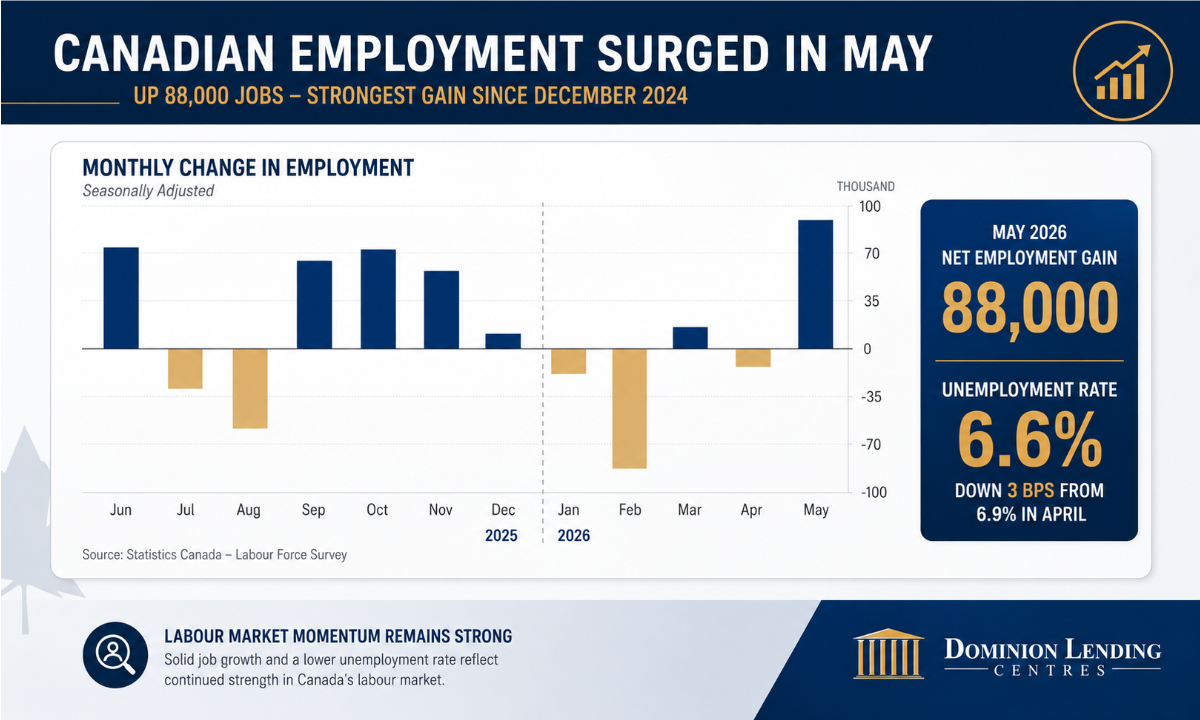
Hiring gains in May were the first significant job growth since November 2025. The increase in May follows a net decline of 112,000 (-0.5%) over the first four months of 2026. On a year-over-year basis, employment was up by 147,000 (+0.7%) in May.
The number of people working full-time rose by 154,000 (+0.9%) in May. The increase in the month offsets a downward trend observed from January to April, in which the number of full-time workers fell by 156,000 (-0.9%). In May, part-time employment decreased by 66,000 (-1.7%).
Employment rose among employees in both the private sector (+56,000; +0.4%) and the public sector (+20,000; +0.4%) in May. The number of self-employed workers was little changed.
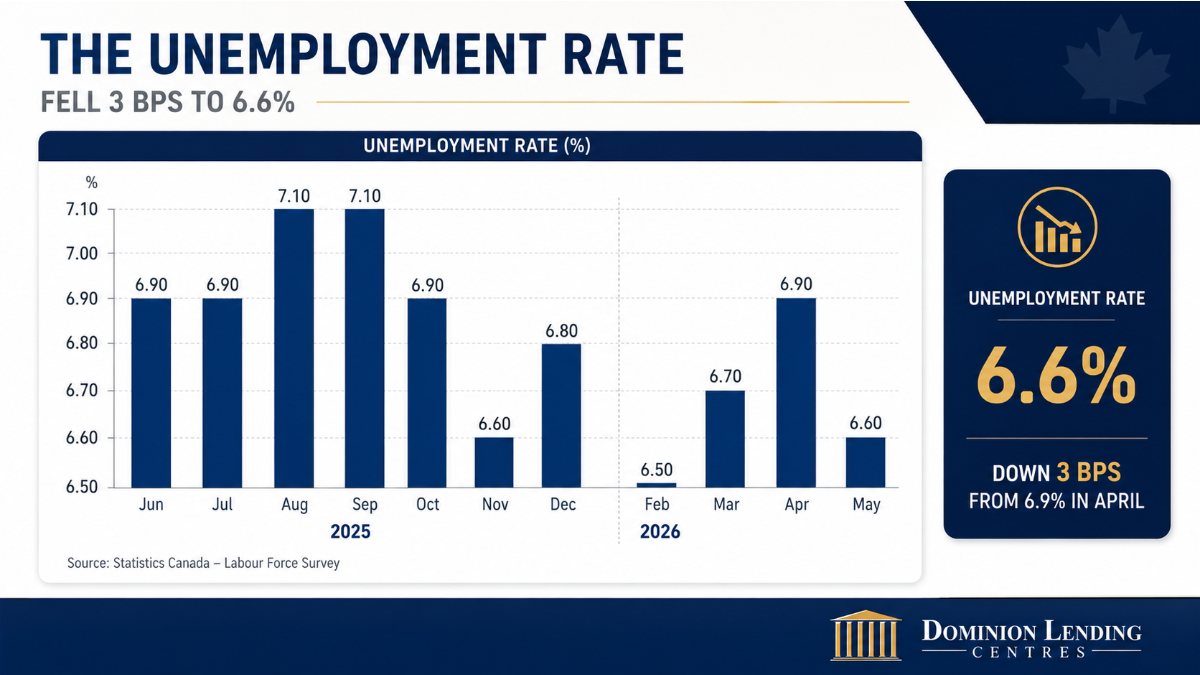
Since the spring of 2024, the unemployment rate has remained above its average (6.0%) observed from 2017 to 2019, prior to the COVID-19 pandemic. The unemployment rate reached a recent peak of 7.1% in August and September 2025.
As employment picked up in May, the job-finding rate ticked up, with just over one-quarter (26.3%) of people who were unemployed in April found work in May. This was up 3.7 percentage points compared with the same period last year but remained below the pre-pandemic average for the corresponding months from 2017 to 2019 (31.5%). At the same time, the layoff rate remained relatively stable at 0.6%, little changed compared with a year earlier and in line with the pre-pandemic average (not seasonally adjusted).
The unemployment rate in the Toronto census metropolitan area fell 1.1 percentage points to 6.8% in May, the lowest level since November 2023. The rate in May 2026 was down from a recent peak of 9.0% in May 2025 and July 2025. Recent declines in Toronto have brought its unemployment rate closer to the rate observed in Montréal (6.5%) and Vancouver (6.4%) in May 2026.
The jobless rate also fell in Montréal (-1.2 percentage points) in May, largely offsetting the increase recorded in the previous month. In Vancouver, the unemployment rate decreased 0.6 percentage points to 6.4%. In both Montréal and Vancouver, the unemployment rate in May was virtually unchanged year over year.
In separate news, US hiring also surged in May, boosting bets on a Fed rate hike. Stocks and bonds in Canada and the US sold off on the news. US job growth topped all forecasts in May, and the unemployment rate held steady at 4.3%, offering the clearest sign yet that the labour market may be breaking out of a prolonged period of lacklustre hiring.
Nonfarm payrolls increased 172,000 last month, and hiring in March and April was stronger than previously reported, according to Bureau of Labour Statistics data out Friday. Taken together, the figures marked the strongest three-month advance in more than two years.
Bottom Line
These blockbuster jobs reports, accompanied by inflation risk stemming from high tariffs and the war in Iran blocking the Strait of Hormuz, are troubling for both stocks and bonds.
The relative weakness of the Canadian labour market will discourage the Bank of Canada from tightening monetary policy too soon. To be sure, inflation remains a risk as higher energy costs become embedded in the price of a wide array of goods and services. The Bank will be reluctant to respond with rate hikes over the next few announcement dates.
Trade negotiations are accelerating as the future of CUSMA is determined. It is hard to imagine the Bank of Canada tightening in the face of such a weak housing market. Early evidence suggests housing activity picked up in May, but the sector remains vulnerable to rising interest rates. Although both the Fed and the BoC have remained on the sidelines so far this year, market-driven interest rates have risen considerably owing to the sharp rise in inflation pressures. Housing is a much larger component of economic activity in Canada than in the US. The Bank of Canada, therefore, will be particularly leery of tightening monetary policy. We hold to the view that central bank rate hikes in Canada and the US are unlikely this year.