Articles
Posted on April 10, 2026
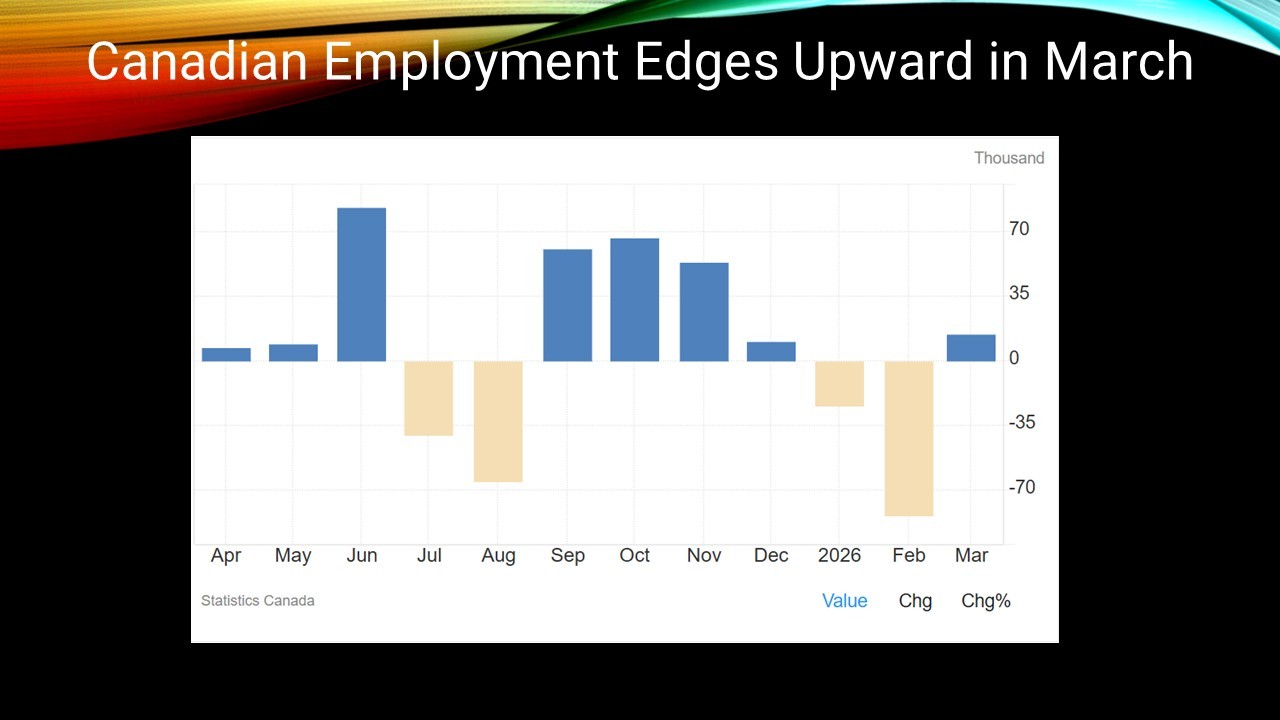
The Canadian Labour Force Survey for March showed a small uptick in employment on the heels of a two-month decline earlier this year.
The Canadian Jobs Report Showed a Small Gain in Net New Employment with the Unemployment Rate Steady at 6.7%
Confusion over a fragile ceasefire continued yesterday as Israel ramped up attacks on Lebanon. The Strait of Hormuz–a key oil shipping route whose closure has sent oil prices skyrocketing in recent weeks–reportedly remained closed. Normally, the Strait accommodates roughly 130 ships a day.
Tehran’s control of the Strait choked off a globally important conduit for oil and gas, as well as the flow of vital materials such as aluminum, helium, fertilizer, and oil components used to make many plastics. Canada is rich in crude and critical minerals, a growing power in liquefied natural gas, and an important supplier of fertilizer and aluminum to the US, though Trump’s tariffs on foreign metals have disrupted the latter industry.
A chunk of global oil production has been taken offline, which could have long-term implications, as the disruption to the free passage of ships through the Strait could linger. Many analysts believe it will take weeks to restore traffic in the Strait to normal levels. These supply disruptions are reminiscent of our COVID experience.
The US sees itself as the enforcer of the free passage of ships in international waters worldwide. If the US backs away from underpinning the free passage of goods, supply disruptions will accelerate.
It was with this backdrop that Statistics Canada released this morning’s Labour Force report. Employment was little changed in March (+14,100; +0.1%) following a cumulative decline of 108,700 (-0.5%) over the first two months of 2026. The number of full-time and part-time workers both showed little variation in March.
On a year-over-year basis, employment was up by 87,000 (+0.4%) in March, largely reflecting gains over the final four months of 2025.
The employment rate—the proportion of the population aged 15 and older who are employed—was unchanged at 60.6% in March, following a cumulative decline of 0.3 percentage points in January and February. The employment rate in March was just above the recent low of 60.5% recorded in August 2025 and was down 0.3 percentage points year over year.
In March, there was little variation in the numbers of public- and private-sector employees and self-employed workers. On a year-over-year basis, the number of employees grew at a faster pace in the public sector (+1.2%) than in the private sector (+0.6%).
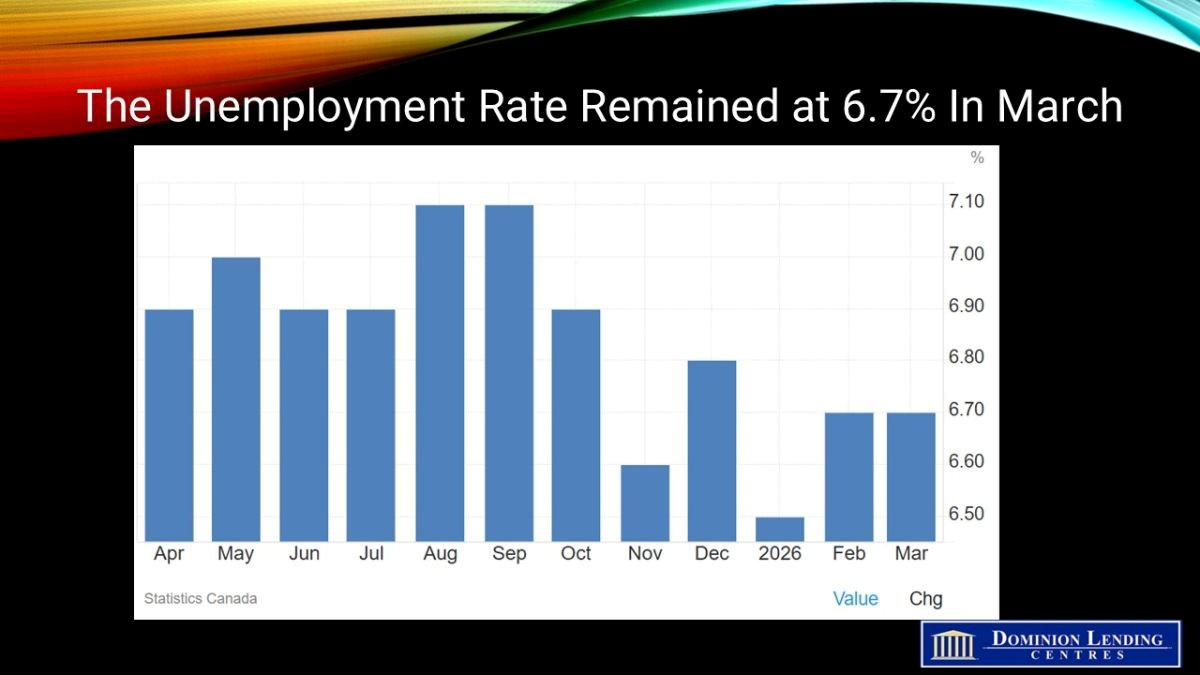
The unemployment rate was unchanged in March at 6.7%, following a 0.2-percentage-point increase in February. The unemployment rate was below the peak of 7.1% recorded in August and September 2025 and was little changed year over year. In comparison, the unemployment rate averaged 6.0% from 2017 to 2019, before the COVID-19 pandemic.
Among people who were unemployed in February, 15.2% found work in March. This was similar to the rate recorded in the same months in 2025 (14.7%) but was below the pre-pandemic average of 19.1% for the same months from 2017 to 2019 (not seasonally adjusted). This indicates that higher unemployment rates relative to the pre-pandemic period are mostly driven by slower hiring, rather than by increased layoffs.
The participation rate—the proportion of the population aged 15 and older who were employed or looking for work—was unchanged at 64.9%. On a year-over-year basis, the labour force participation rate was down 0.4 percentage points.
Average hourly wages surged unexpectedly to a 4.7% y/y pace, the fastest in more than a year and well up from 3.9% the prior month. Wages can be a volatile series, but that’s a big bounce, and a move that the Bank of Canada will be watching closely. Meantime, total hours worked edged up 0.2% m/m after a deep dive in February. That still left hours worked down by 0.4% annually for all of Q1. The current consensus forecast for real GDP growth of 1.5% now hinges on an improvement in productivity growth.
Employment rose in ‘other services’ (+15,000; +1.9%) in March, offsetting a similar-sized decline in February. Employment in this industry, which includes repair and maintenance services, was little changed compared with 12 months earlier.
Employment change by industry, March 2026
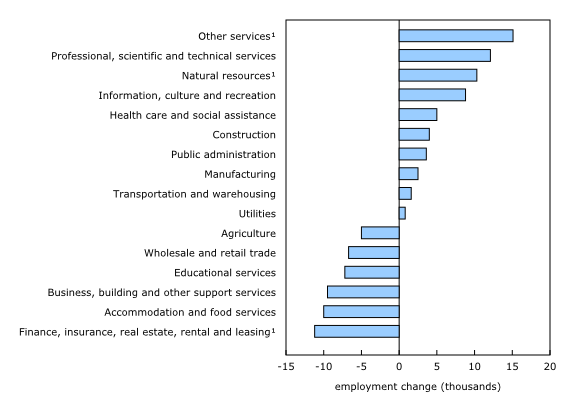
Employment in natural resources also increased (+10,000; +3.0%), with nearly half of those gains coming from Alberta (+4,500; +3.2%). On a year-over-year basis, employment in this industry was little changed at the national and Alberta levels.
On the other hand, employment in finance, insurance, real estate, rental and leasing fell by 11,000 (-0.8%) in March, the first significant monthly decline since November 2023.
Although employment in health care and social assistance was little changed in March, it was up 94,000 (+3.3%) compared with 12 months earlier, the largest employment growth among industries. Over that same period, the largest employment decline among industries was in manufacturing (-44,000; -2.4%).
Bottom Line
In other news, the US CPI for March, released this morning, surged the most in nearly four years as the war with Iran sent gasoline prices skyrocketing. The CPI spiked 0.9% from February. Year-over-year inflation increased to 3.3%, the strongest pace since 2024. A record rise in gasoline prices was responsible for nearly three-quarters of the monthly advance. Core inflation rose at a slower 0.2% pace monthly pace.
The data underscore how the war in the Middle East is beginning to ripple through the global economy, worsening households’ affordability woes. Gas prices have already surged at the pump, and, according to Bloomberg News, service providers, including Delta Air Lines and the US Postal Service, have warned of price hikes ahead.
The Canadian CPI data for March will be released on Monday, April 20, before the April 29 Bank of Canada announcement. The data will undoubtedly show a spike in price pressures, but given the geopolitical uncertainty regarding how long the disruption to oil tanker traffic will last, the Bank of Canada is likely to keep its powder dry at the next meeting. There is a real risk of stagflation, so inaction is the likely outcome, for fear of worsening tepid economic growth in response to what everyone hopes is a temporary surge in oil prices.