Articles
Posted on November 16, 2026
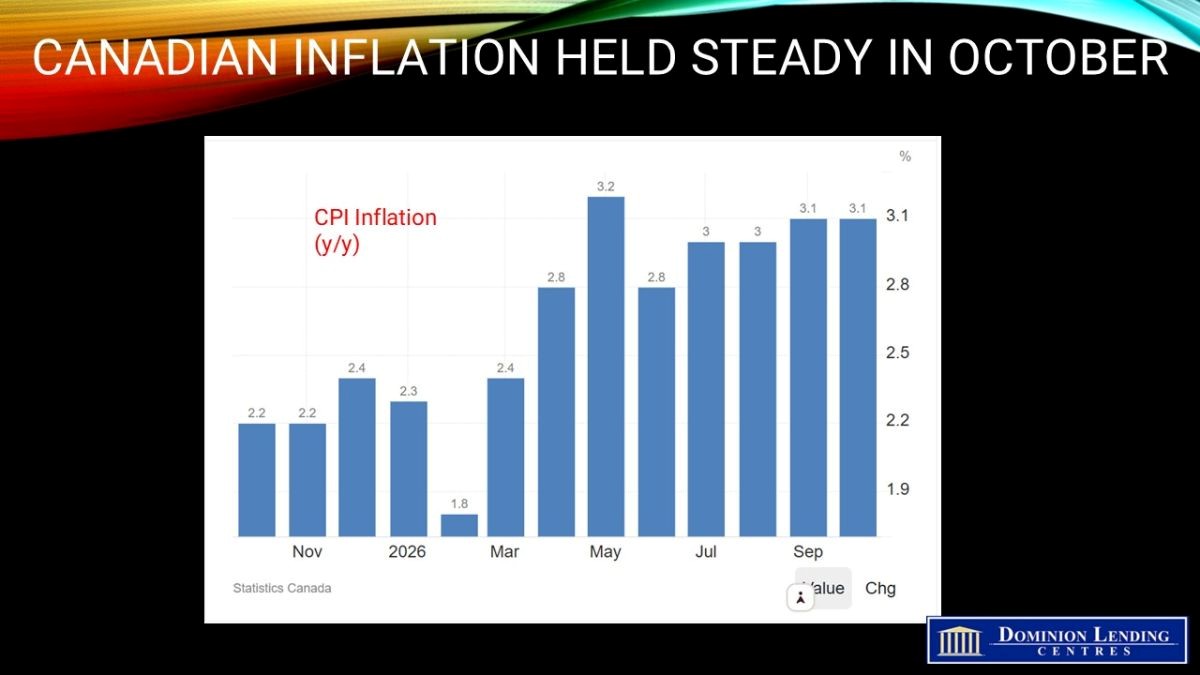
Canada’s inflation rate held at 3.1% in October as higher energy prices rose, while cell phone plans and rent price growth slowed.
Good News On the Canadian Inflation Front
The Consumer Price Index (CPI) rose 3.1% year over year in October, matching September’s rise. This contrasts sharply with the surge in US CPI inflation reported last week.
Upward pressure on the all-items CPI in October was broad-based, driven by higher prices for natural gas, gasoline, groceries, and clothing. Conversely, lower prices for cell phone plans and slower rent price growth put downward pressure on headline inflation. Excluding energy, the CPI rose 2.0% in October, after increasing 2.1% in September.
The CPI increased 0.2% month over month in October. Seasonally adjusted, the CPI rose 0.2%.
Year over year, gasoline prices rose faster in October (+30.9%) than in September (+27.8%), partly due to a base-year effect. In October 2025, crude oil prices were lower due to oversupply concerns, leading to a 4.8% monthly decline in gasoline prices. This decrease is no longer impacting the 12-month movement, putting upward pressure on the gasoline index in October 2026.
Although gasoline prices fell month over month in October (-2.5%), levels remained elevated amid continued uncertainty over geopolitical conflicts in the Middle East and Ukraine.
After four consecutive months of slower price growth, prices for food purchased from stores rose faster year over year in October (+2.0%) than in September (+1.7%).
Higher prices for fresh vegetables drove the year-over-year acceleration in grocery prices, up 1.4% in October after falling 2.9% in September. Price increases for sugar and confectionery (+0.4%) and condiments, spices and vinegars (+2.6%) also contributed to accelerating grocery inflation.
Despite the acceleration in price growth, this was the third consecutive month that grocery inflation increased more slowly than the all-items CPI. However, compared with October 2020, grocery prices have risen 31.9%.
After declining 0.3% year over year in September, clothing prices rose 1.8% in October. The increase was driven by higher prices for women’s clothing (+2.2%) and men’s clothing (+1.4%).
Clothing prices rose 3.4% month over month in October, the largest monthly increase since September 2019 (+5.3%). The October 2026 price increase coincided with higher shipping costs.
Prices for cellular services fell 6.2% year over year in October, following a 0.8% increase in September. Several wireless service providers increased prices on cell phone plans in October 2025, with prices rising 8.2% month over month. This increase no longer influences the 12-month price movement, putting downward pressure on the cellular services index.
Year over year, prices rose more slowly in five provinces in October than in September. The deceleration in British Columbia was mainly due to a year-over-year slowdown in rent prices.
In Ontario, natural gas prices rose 3.0% year over year in October after declining 18.7% in September. Following a one-time rate increase in July 2025, natural gas prices fell 22.4% month over month in October 2025 as prices returned to earlier levels. This decline has now fallen out of the 12-month movement, putting upward pressure on natural gas prices in Ontario in October 2026.
Offsetting the year-over-year increase in natural gas prices in October in Ontario was slower price growth for property taxes (+3.3%) and rent (+1.1%).
Property taxes and other special charges, which are priced annually in October, rose 3.8% nationally, compared with October 2025 (+5.6%). Slower price growth in Manitoba in 2026 (+4.5%) compared with 2025 (+19.5%) also contributed to the deceleration, as prices rose in part due to higher sewer and garbage fees in Winnipeg. Property taxes rose fastest in Newfoundland and Labrador, up 5.9% in 2026, after a 2.6% gain in 2025. Property taxes and other special charges are determined by four factors: the assessed value of homes and land; municipal and provincial tax rates; charges levied by municipalities for specific services such as wastewater and garbage collection; and homeowner tax rebates.
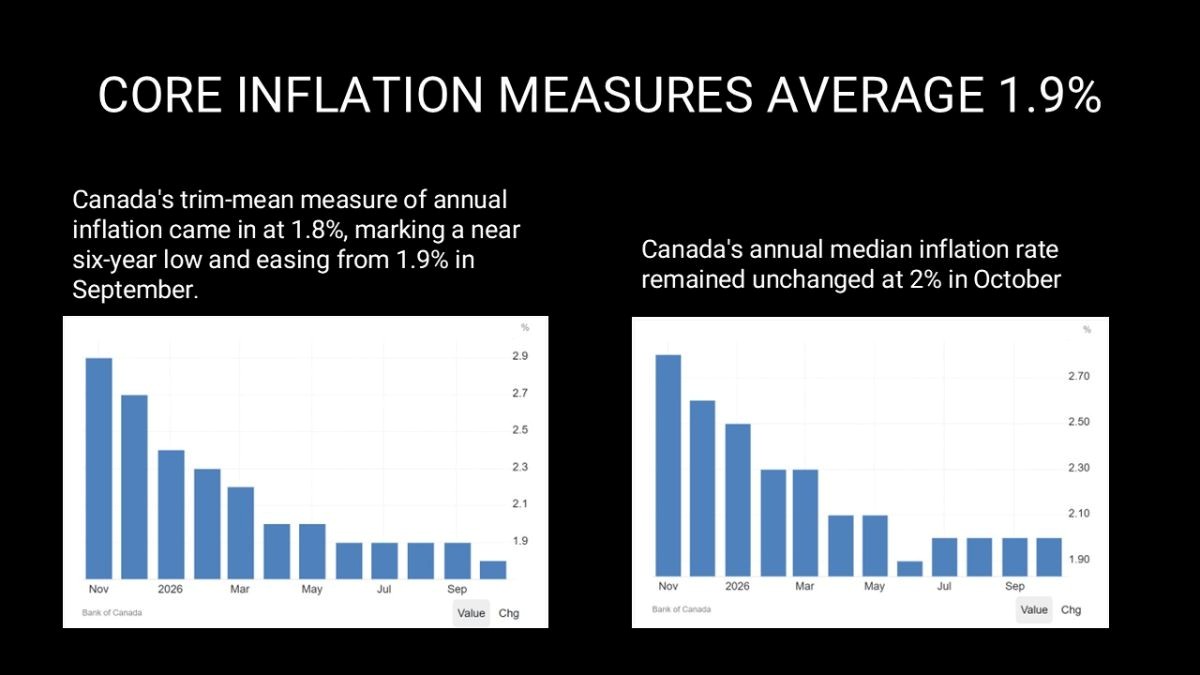
The central bank’s favourite measures of core inflation average 1.9% and continue to behave well.
Bottom Line
Today’s inflation report reinforces our view that higher gasoline prices temporarily boost headline inflation while further eroding household purchasing power. However, these energy-driven increases, largely tied to geopolitical tensions, are unlikely to trigger a broader resurgence in underlying inflation.
At the same time, recent labour force data have underscored some of the economic vulnerabilities facing Canada as the US trade war drags on. Employment fell in Canada by 41,200 since the end of last year, the largest year-to-date loss since the 2009 financial crisis, excluding 2020 during the Covid-19 pandemic
Washington appears to be backing away from the Iran war, suggesting that no further bombing will be necessary. Goldman Sachs expects an excess supply of energy to materialize as we move into next year. The Federal Reserve is widely expected to tighten monetary policy once again in December. The likelihood of a Bank of Canada rate hike should be tempered by the more muted Canadian inflation report.