Articles
Posted on November 6, 2026
Another Weak Canadian Labour Force Survey for October.
Another Weak Labour Market Report For October
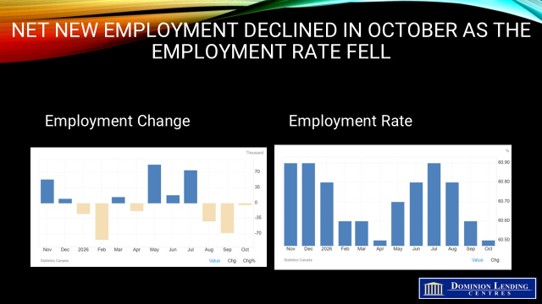
Employment fell again in October, continuing a stream of lacklustre labour force surveys. Canadian net employment edged downward (-4,700; 0.0%) and the employment rate fell a tick to 60.5%. Employment declined by 68,000 in September and by 42,000 in August.
The employment rate—the percentage of the population aged 15 years and older who are employed—decreased 0.1 percentage points to 60.5% in October, marking a third consecutive monthly decline.
In the 12 months to October, employment recorded little net variation (+17,000; +0.1%) and the employment rate fell 0.3 percentage points.
Private sector employment fell by 53,000 (-0.4%) in October, the first decline since February. At the same time, public sector employment rose by 50,000 (+1.1%) in October, after four consecutive monthly declines totalling 148,000 (-3.2%). Year on year, public sector employees fell by 70,000 (-1.5%), while private sector employees rose slightly by 35,000 (+0.3%). Self-employment was little changed in October and was up by 52,000 (+1.9%) compared with 12 months earlier.
The unemployment rate rose 0.1 percentage points to 6.5% in September. Earlier in the year, it reached a recent peak of 6.9% in April, before declining to 6.4% in July and August. The unemployment rate in September was the same as it was at the start of the year (6.5% in January).
The layoff rate—representing the proportion of people who were employed in August but had become unemployed in September as a result of a layoff—was 0.7%, similar to the rate observed a year earlier (0.6%) and the average during the period from 2017 to 2019 (0.6%) (not seasonally adjusted).
The job-finding rate was 30.6% in September, down from 32.8% 12 months earlier and below the average of 36.5% during the period from 2017 to 2019. This refers to the proportion of people who were unemployed in August and had found a job in September.
The labour force participation rate—the proportion of the population aged 15 and older who were employed or looking for work—fell 0.2 percentage points to 64.8% in September. This was the lowest level since December 1997 (when it was also 64.8%), excluding 2020 during the COVID-19 pandemic. Year over year, the participation rate fell 0.4 percentage points in September 2026, largely due to population aging.
While older Canadians are participating in the labour market at higher rates relative to previous cohorts, there is nonetheless a drop-off in participation rates at older ages, especially for those aged 65 and older.
In September 2026, people aged 65 and older accounted for 23.2% of the working-age population (i.e., those aged 15 and older) in the Labour Force Survey, up from 20.5% in September 2019, prior to the COVID-19 pandemic. In comparison, this share was 14.8% at the turn of the millennium.
The upward trend in the share of people aged 65 and older in the working-age population was briefly paused in 2023 and 2024, as sharp increases in permanent and temporary immigration offset the aging of the population. However, in 2025 and into 2026, the trend towards an aging population resumed.
The lower labour force participation rate observed in September 2026, relative to a year earlier and to the pre-pandemic period, can largely be attributed to population aging. Using a method that holds constant the September 2019 age composition of the population, the participation rate in September 2026 would be little changed (-0.1 percentage points) year over year and would be 0.2 percentage points higher than in September 2019.
By sector, fewer people worked in educational services, Health care and social assistance, and manufacturing. Regionally, employment declines were posted in Quebec and British Columbia, while energy-heavy Alberta enjoyed continuing job gains. Alberta’s unemployment rate was 6.4% in September, down both month-over-month (-0.4 percentage points) and year-over-year (-1.3 percentage points).
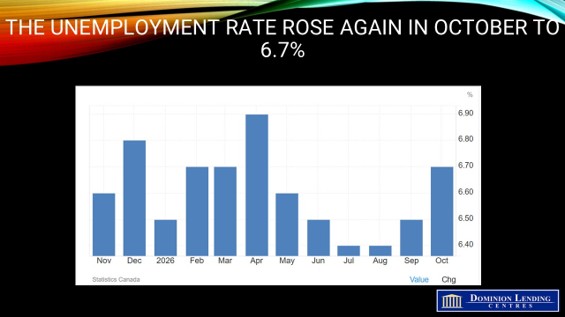
Canada’s unemployment rate rose to 6.7% in October 2026 from 6.5% in September, reaching its highest level since April and exceeding expectations that it would remain unchanged at 6.5%. The labour market showed signs of stalling as US tariffs continued to weigh on some sectors. Unemployment rose by 32,800 to 1,507,700. Nearly one-quarter (23.7%) had been unemployed for at least 27 weeks. The share was highest among those aged 55 and over (32.7%), while it stood at 25.3% among core-aged workers. Unemployment rates for core-aged people were unchanged for both men (5.8%) and women (5.3%). Young people continued to have the lowest proportion of long-term unemployment at 15.2%, although their unemployment rate rose to 13.7% as employment edged down and more people entered the labour force to seek work. The labour force participation rate remained unchanged at 64.8%, while the number of employed persons fell by 4.7 thousand.
Employment in Alberta fell by 24,000 (-0.9%) in October, offsetting a similar-sized increase in September (+23,000; +0.9%). Year over year, employment in the province rose by 41,000 (+1.6%) in October. Alberta’s unemployment rate was 7.3%, up 0.9 percentage points in the month and little changed from 12 months earlier.
Meanwhile, employment in British Columbia rose by 12,000 (+0.4%) in October, after falling in the previous month (-20,000; -0.7%). The unemployment rate in the province stood at 6.3% in October, little changed month-over-month and compared with 12 months earlier.
Employment in Quebec held steady in October, following a cumulative decline of 68,000 (-1.5%) in August and September. Year over year, employment in Quebec fell by 106,000 (-2.3%) in October. The unemployment rate fell 0.3 percentage points to 5.7% as fewer people searched for work. Despite the October decline, Quebec’s unemployment rate was up 0.4 percentage points compared with 12 months earlier.
In Ontario, employment was little changed for a third consecutive month in October. The unemployment rate rose 0.3 percentage points to 7.3% as more people searched for work. Year over year, employment in Ontario was little changed, and the unemployment rate fell 0.3 percentage points.
Bottom Line
In contrast to Canada’s weak jobs report, US job growth surged in October, while the unemployment rate edged lower, signalling a strong labour market. Nonfarm payrolls rose 165,000, beating expectations. The jobless rate fell to 4.1%. The US economy is running red hot, largely driven by the AI infrastructure build-out.
Trader bets on a December interest-rate hike moved up after the data, with investors now seeing a 78% chance of an increase that month. The much weaker Canadian economy can ill afford additional rate hikes. In contrast, traders trimmed bets on a Canadian rate hike as the jobless rate continued to rise.
Canada’s budget, released last night, relaxed the foreign buyer ban on newly constructed housing, but extended the ban for all other purchases for two years.
The government is earmarking tens of billions of dollars to reduce homelessness and expand the country’s social housing stock, with a goal of ending homelessness in a decade. The federal budget includes C$45 billion for housing measures over 10 years, with C$11.2 billion allocated to build supportive and transitional housing and address mental health and addictions.
After some speculation on whether the federal government would increase immigration levels, it opted to keep targets steady over the next three years. It intends to welcome 370,000 temporary residents and 380,000 permanent residents each year through 2029.