Articles
Posted on February 18, 2026
Canadian home sales fell 5.8% m/m in January, depressed by record winter storm in Ontario
Housing Activity Fell Again in January–Depressed by Record Winter Storm
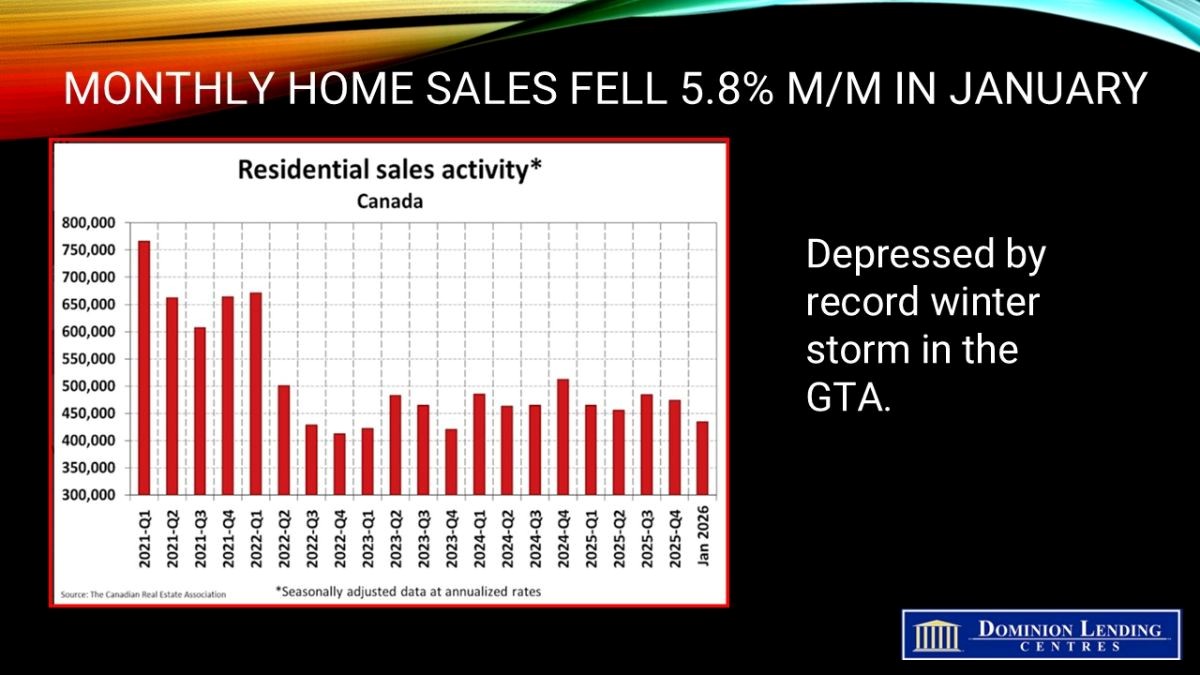
Today’s release of January housing data by the Canadian Real Estate Association (CREA) showed the housing market frozen solid by the record winter storms. Both home sales and prices continued their downward trend, but have yet to attract the beleaguered first-time homebuyer.
The number of home sales recorded over Canadian MLS® Systems fell 5.8% on a month-over-month basis in January 2026.
“The monthly decline in national home sales was driven primarily by less activity in the Greater Golden Horseshoe and Southwestern Ontario, suggesting that the story was probably more about a historic winter storm than a downshift in demand,” said Shaun Cathcart, CREA’s Senior Economist. “Notwithstanding the chilly start to the year, we continue to expect 2026 will ultimately be defined by pent-up demand from first-time buyers finally seeing a chance to enter the market.”
New Listings
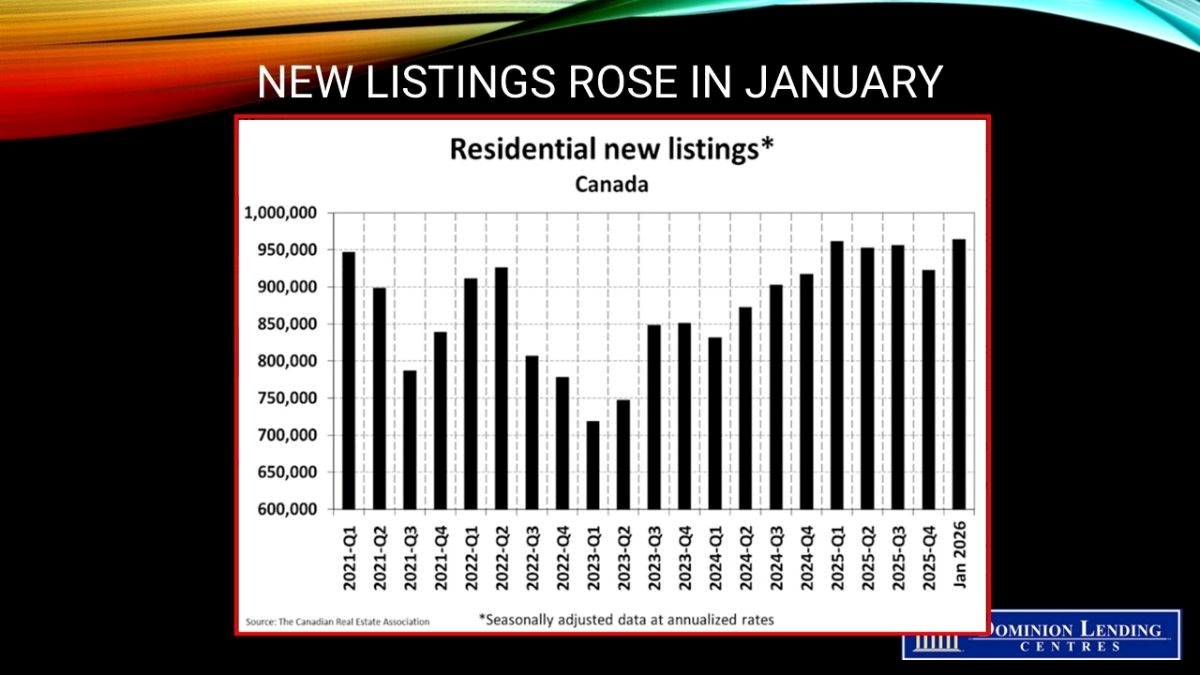
Similar to what happened in January 2025, new supply increased month over month in January 2026, rising 7.3% as sellers appeared eager to start the year.
The burst of new supply was driven by about two-thirds of local markets, and led by Montreal, Quebec City, Calgary, Greater Vancouver, and Victoria. Meanwhile, Central and Southwestern Ontario were far less prominent and, in many cases, recorded declines. This reinforces the view that winter weather was a primary factor in January in those regions, as it appears to have suppressed both demand and supply.
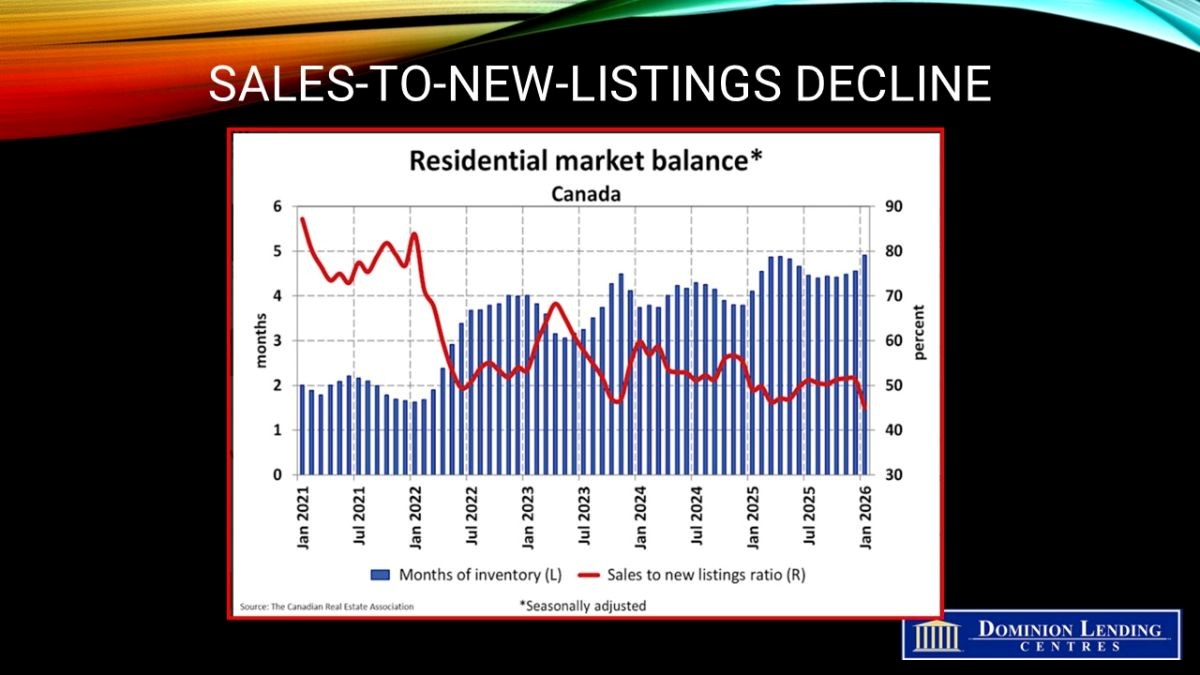
With a rare combination of a sizeable increase in new listings and a sharp slowdown in sales in January, the national sales-to-new listings ratio dropped to 45% compared to 51.3% at the end of 2025. The long-term average for the national sales-to-new-listings ratio is 54.8%, with readings generally between 45% and 65%, consistent with balanced housing market conditions.
There were 140,680 properties listed for sale on all Canadian MLS® Systems at the end of January 2026, up 4.5% from a year earlier but 11.4% below the long-term average for that time of year.
There were 4.9 months of inventory nationally at the end of January 2026, up from 4.6 months at the end of December. The long-term average for this measure of market balance is five months of inventory. Based on one standard deviation above and below that long-term average, a seller’s market would be below 3.6 months, and a buyer’s market would be above 6.4 months.
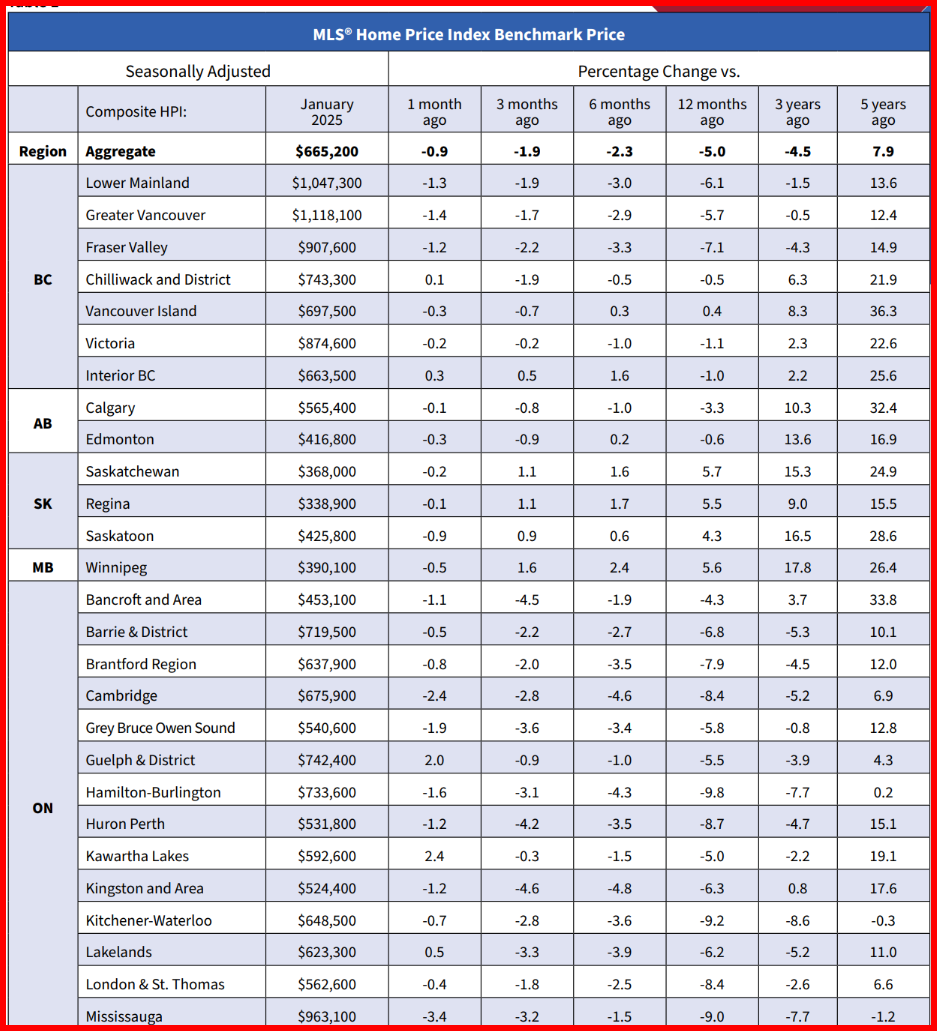
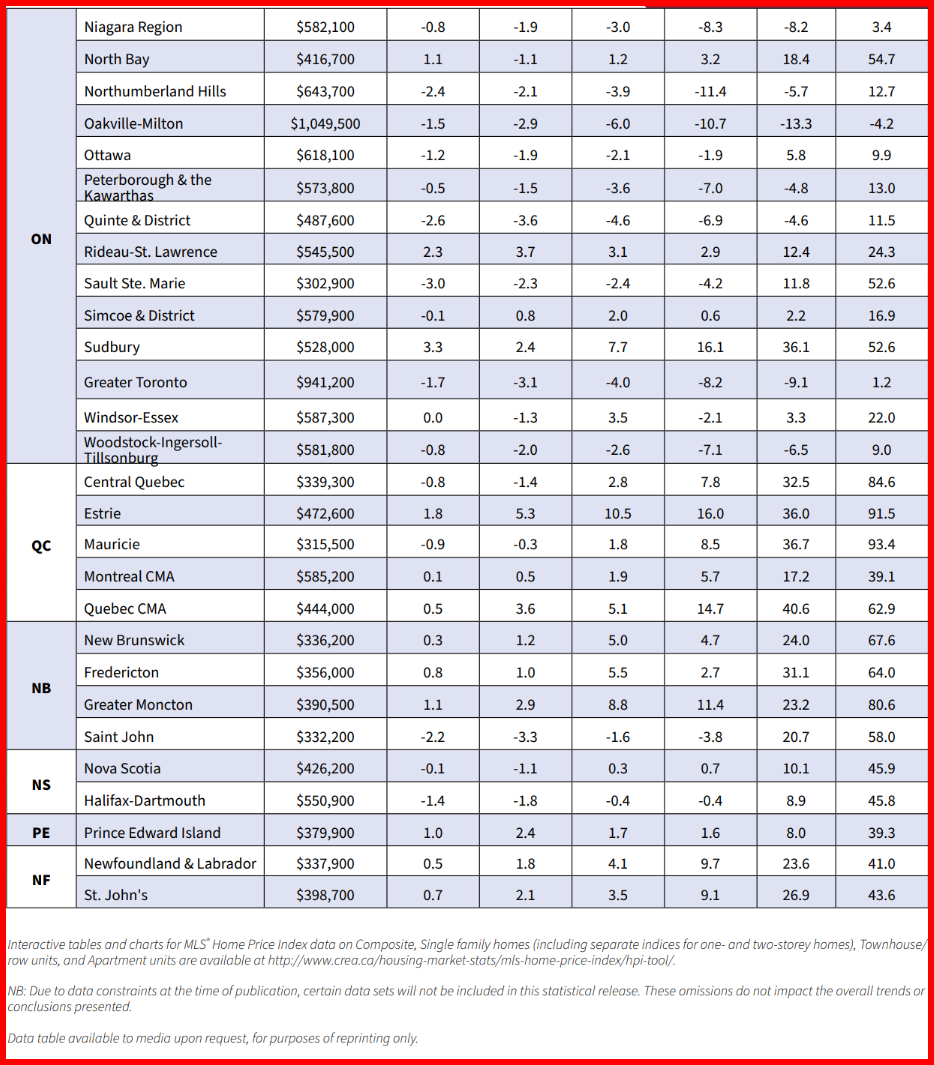
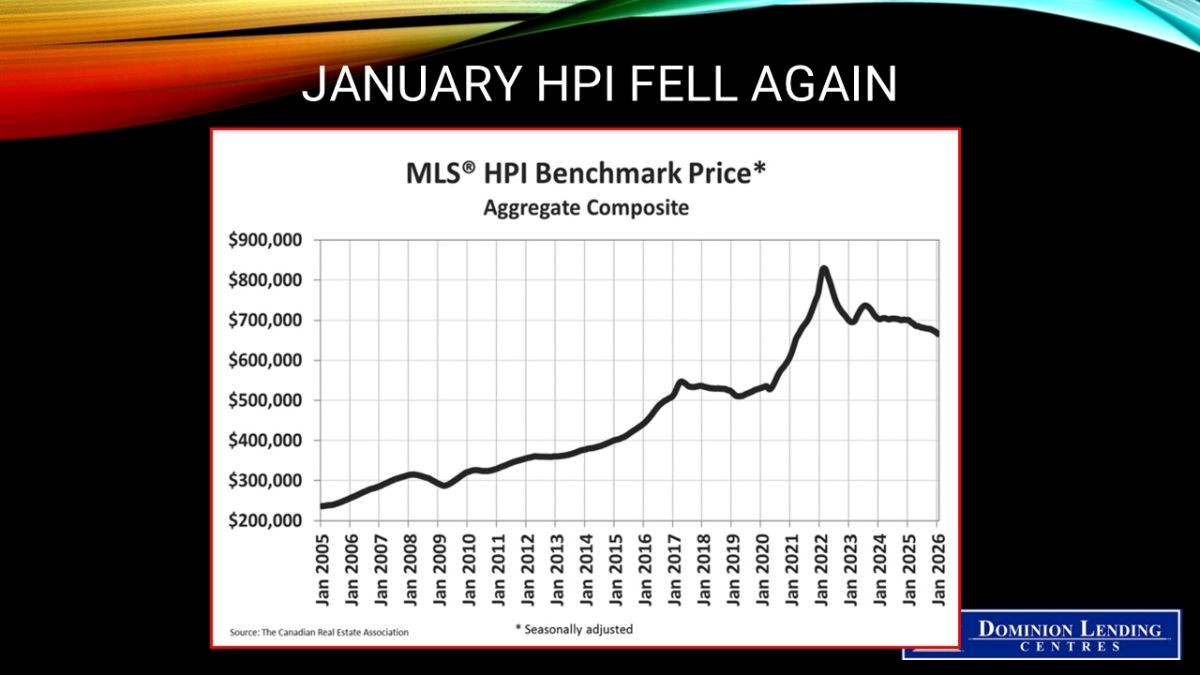
In line with more supply and less demand in January 2026, the National Composite MLS® Home Price Index (HPI) fell by 0.9% on a month-over-month basis.
The non-seasonally adjusted National Composite MLS® HPI was down 4.9% compared to January 2025.
Regionally, prices remain down year over year in British Columbia, Alberta, and Ontario, offsetting gains in other provinces. An analysis by city shows the largest year-over-year declines dip into double digits in Hamilton-Burlington and Oakville-Milton, contrasted with double-digit gains in Sudbury, Quebec City, and St. John’s, Newfoundland.
Home Prices
Regionally, prices remain down year over year in British Columbia, Alberta, and Ontario, offsetting gains in other provinces. An analysis by city shows the largest year-over-year declines dip into double digits in Hamilton-Burlington and Oakville-Milton, contrasted with double-digit gains in Sudbury, Quebec City, and St. John’s, Newfoundland.
Bottom Line
Today’s data end a year that saw house prices drift lower despite falling interest rates, as a simmering trade war with Canada’s largest trading partner caused higher unemployment and considerable job uncertainty. Although U.S. tariffs affect only a limited volume of Canadian goods, and the economy hasn’t tipped into a recession, the unpredictability of President Donald Trump’s trade policy has stoked economic insecurity.
In some regions, the price decline has now wiped out a sizable share of the gains homeowners saw during the torrid Covid market from 2020 to 2022, when overnight interest rates were reduced to a record low of 25 basis points. Back then, ultralow interest rates drove home prices to surge, particularly in smaller cities where remote workers fled to take advantage of a lower cost of living.
There is considerable pent-up demand among potential first-time buyers who will likely dip their toes in the market once winter passes. This year, we also see a record volume of refis and renewals, which will increase monthly mortgage payments and dampen household purchasing power. Affordability remains a challenge for first-time buyers, but mortgage rates and prices are considerably below year-ago levels. A reawakening of housing activity is likely as the spring market approaches.
With inflation well-behaved, the Bank of Canada has the flexibility to cut the overnight rate further if the economy falters.