Articles
Posted on August 7, 2026
Surprisingly Strong Employment Report Confirms Economy’s Resilience
So Much For Recession Worries, The July Jobs Report For Canada Was A Blockbuster
Surprisingly strong employment gains in July confirm the economy is recovering from its Q4-’25 to Q1-’26 weakness. This is consistent with the strong July GDP figures, which point to 3.8% growth in the second quarter following a -1.0% dip in Q1.
Canadian employment defied the bears by jumping 75,100 in July, nearly evenly split between full-time and part-time work. Self-employment (+44.4k) accounted for over half of the overall increase, but private sector jobs still rose by 57.9k, offset by a 27k drop in public sector jobs (a rarity, echoing the big drop seen stateside in July). Decisively, total hours worked rose 0.6% m/m in July.
Employment increased by 181,100 between May and July, marking the biggest three-month employment gain since before US President Donald Trump began imposing tariffs on Canadian goods.
The employment rate—the proportion of the population aged 15 and older who are employed—increased by 0.1 percentage points to 60.9% in July. The rate was up 0.2 percentage points compared with 12 months earlier.
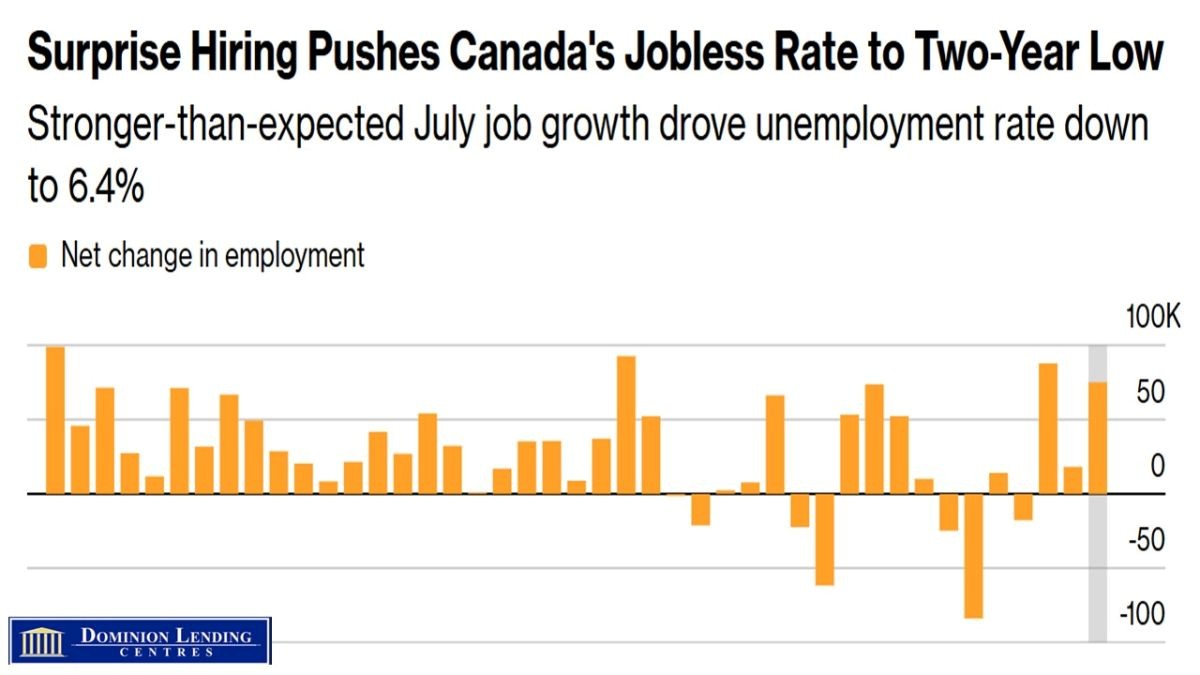
Today’s report marked the third consecutive monthly decrease for the unemployment rate, which has fallen by 0.5 percentage points since April. The rate was also down 0.5 percentage points year-over-year in July.
A higher proportion of people searching for work have been finding jobs compared with last year. The job-finding rate—the proportion of unemployed people who found a job between June and July—was 20.8%. This was up from 18.5% for the same period a year earlier but below the pre-COVID-19 pandemic average of 26.6% recorded for the same period from 2017 to 2019 (not seasonally adjusted). Canada’s population barely grew in the past year given the tightening in immigration policy, making it easier for the jobless to find work.
Wholesale and retail trade (+21,000; +0.7%) recorded the largest employment increase across industries in July. Despite the monthly increase, employment in this industry was down by 50,000 (-1.7%) compared with 12 months earlier, largely reflecting a downward trend observed from January to May 2026.
Chart 5 : Employment change by industry, July 2026
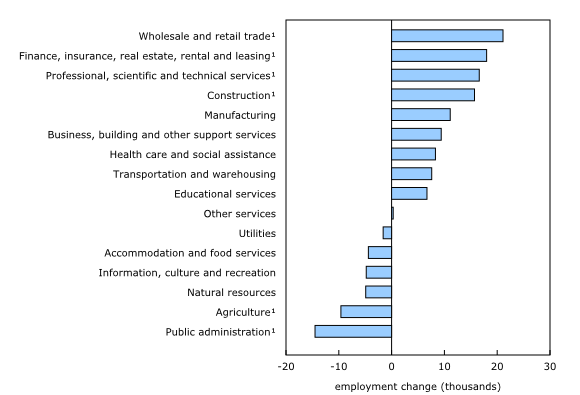
Employment also rose in July in finance, insurance, real estate, rental and leasing (+18,000; +1.2%), professional, scientific and technical services (+17,000; +0.8%) and construction (+16,000; +1.0%). Despite recording monthly gains, employment in these three industries changed little on a year-over-year basis.
Employment in Ontario increased by 52,000 (+0.6%) in July, the third increase in four months, with a net gain of 119,000 (+1.5%) over this period. The unemployment rate in Ontario declined by 0.2 percentage points to 6.8% in July. The rate was down from a recent high of 7.9% in December 2025 and was the lowest rate for this province since July 2024.
Employment in British Columbia was up by 18,000 (+0.6%) in July, continuing an upward trend since May. The unemployment rate in British Columbia (6.2%) was down for the second consecutive month in July from a recent high of 6.8% in May 2026. Employment rose in Manitoba (+5,900; +0.8%) in July, the first monthly increase since March. The unemployment rate in the province was down 0.4 percentage points to 5.0% in July, matching the rate in April.
In Nova Scotia, employment increased by 4,600 (+0.9%) in July, marking the second consecutive monthly increase. Year over year, employment in this province was up by 12,000 (+2.4%). The unemployment rate in Nova Scotia was 6.2%, little changed in the month but down 0.7 percentage points compared with 12 months earlier.
Employment in Quebec changed little in July and over the past 12 months, and the unemployment rate was at 5.6% over the same periods.
In Alberta, employment was modest in July but was up by 91,000 (+3.5%) on a year-over-year basis, the largest proportional increase among the provinces. The unemployment rate in Alberta held steady at 7.0% in July and was down 0.9 percentage points compared with the same month in 2025. Employment in Quebec was little changed both in July and compared with 12 months earlier, and the unemployment rate was also little changed at 5.6% over the same periods.
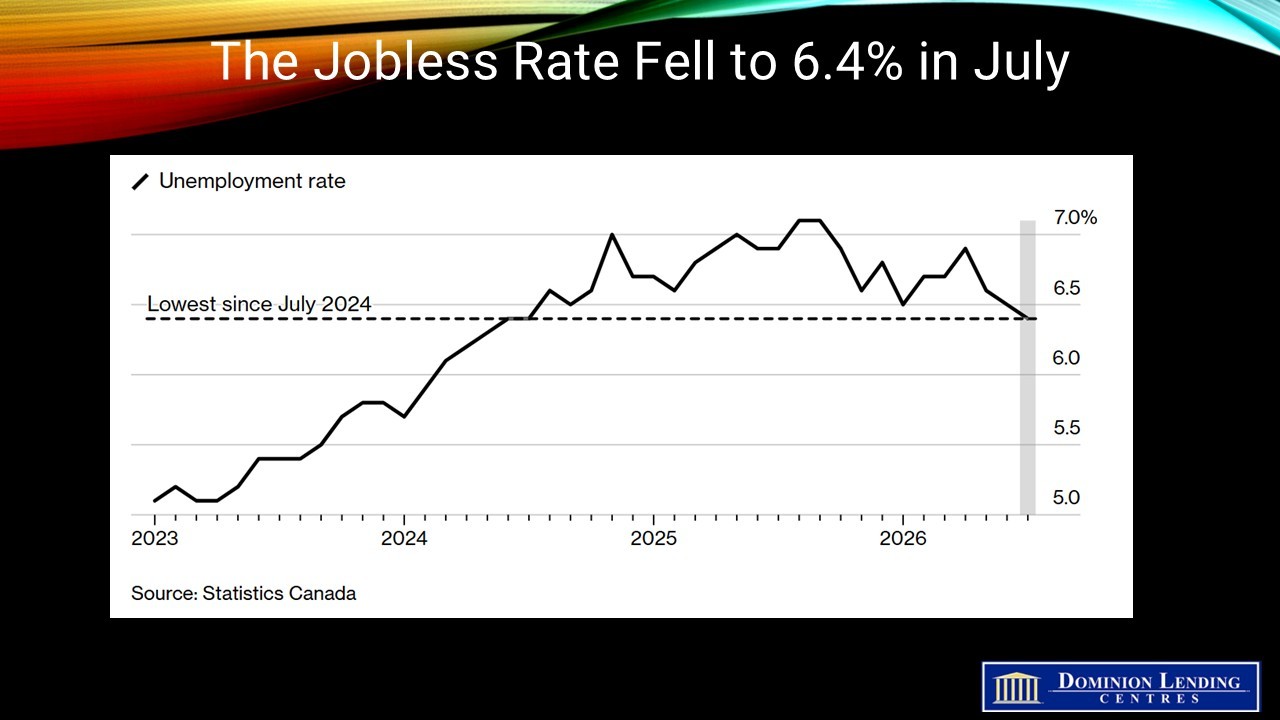
The unemployment rate dipped again to 6.4%, down from 6.5% in June. This represents a two-year low in joblessness, down from the recent peak of 7.1% in September. The unemployment rate has fallen by half a percentage point since the spring. The Bank of Canada will see this as further tightening in the job market.
Among the three largest census metropolitan areas, the unemployment rate rose by 0.7 percentage points to 6.6% in Montréal, offsetting a similar-sized decline in the previous month. In Vancouver, the unemployment rate fell 0.6 percentage points to 6.0% in July. The unemployment rate was little changed in Toronto at 6.7%; however, it was down from a recent high of 9.0% observed in July 2025.
In direct contrast to the Canadian jobs report, the US nonfarm payroll report was much weaker than expected. US employers unexpectedly cut jobs in July and hiring in the prior two months was revised lower, suggesting the labour market is weaker than previously thought after surprising strength earlier this year. Nonfarm payrolls decreased 23,000 last month following a combined 103,000 downward revision to the May and June figures, Bureau of Labour Statistics data showed Friday. The unemployment rate fell to 4.1% as labour force participation continued to slide, and wage growth slowed.
According to Bloomberg news, the US labour market may be starting to falter amid rising prices and uncertainty from the Iran war, despite recent data showing strength in consumer spending and business investment. The data could also prompt the Federal Reserve to delay interest-rate increases as officials measure inflation against risks to employment.
Bottom Line
Employment increased by 181,100 between May and July in Canada, marking the biggest three-month employment gain since before US President Donald Trump began imposing tariffs on Canadian goods. These blockbuster Canadian jobs reports, accompanied by inflation risk stemming from high tariffs and the war in Iran blocking the Strait of Hormuz, are troubling for both stocks and bonds.
While the economy continues to show signs of stabilization, trade uncertainty still looms. US President Donald Trump has threatened to impose a new round of 50% tariffs on a number of Canadian goods starting Aug. 19.
Canadian officials met with US Trade Representative Jamieson Greer on Thursday as the two sides try to find a deal before Trump’s deadline.
With wage growth decelerating further and energy prices more moderate, the Bank of Canada won’t take on a more hawkish tone yet, though a strengthening economic backdrop could eventually push it in that direction if it persists.