Articles
Posted on October 28, 2026
The Bank of Canada raises the overnight policy rate by 25 bps to 2.5%, the first hike since
Bank of Canada Raises the Overnight Rate to 2.5%, Says More May Be Needed
Today, the Bank of Canada raised the overnight rate by 25 bps to 2.5%, joining the six other G-10 central banks that have tightened monetary policy to combat inflation. The Federal Reserve hiked the fed funds rate at its last meeting and is expected to hike rates again this afternoon. Washington may delay the next hike until after the midterm elections.
The BoC’s decision was difficult, as labour markets are soft and economic activity and inflation are more muted than in the US. The labour market has shed jobs two months in a row, while US tariffs and reduced immigration are creating headwinds for some sectors. Macklem is concerned that inflation will remain above target for an extended period and warns that additional increases in borrowing costs may be needed. The Bank estimates the neutral range for interest rates is 2-1/4%-to-3-1/4%.
But policymakers appear to be less worried now about some of those downside risks. The Bank has said the damage from the escalation in trade tensions will largely be concentrated in a small number of sectors.
Fiscal policy is also helping to cushion the economy. Prime Minister Mark Carney’s government has reduced gasoline taxes and, along with Ontario’s government, provided relief programs to manufacturing sectors hit hard by tariffs. We will know more on the fiscal front when Ottawa brings down the budget on November 5.
Throughout the trade disputes, Macklem and the bank have argued that governments are better positioned to help households, industries and regions being hurt most by tariffs. The central bank can only set short-term borrowing costs based on broader economic conditions.
Some provinces, like Ontario, Quebec and British Columbia, are being hit by tariffs and the slower housing market, while oil-rich provinces like Alberta and Saskatchewan are benefiting from higher energy and commodity prices.
Housing activity remains subdued, and prices are still sliding in some markets. But Senior Deputy Governor Carolyn Rogers reminded people in a recent speech that the central bank doesn’t set interest rates just for the housing market.
Headline inflation has been stuck around 3% for months because of elevated gasoline prices. Core inflation has held near the central bank’s 2% target so far, and there’s scant evidence higher energy costs are feeding through more broadly.
Other signs could worry officials if the Middle East conflict continues. The Bank’s surveys show consumers’ longer-term inflation expectations have ticked higher, while companies increasingly expect to pass higher input costs on to their customers.
“Uncertainty” seems to be the key word for Macklem during this press conference. He’s reiterated it numerous times.
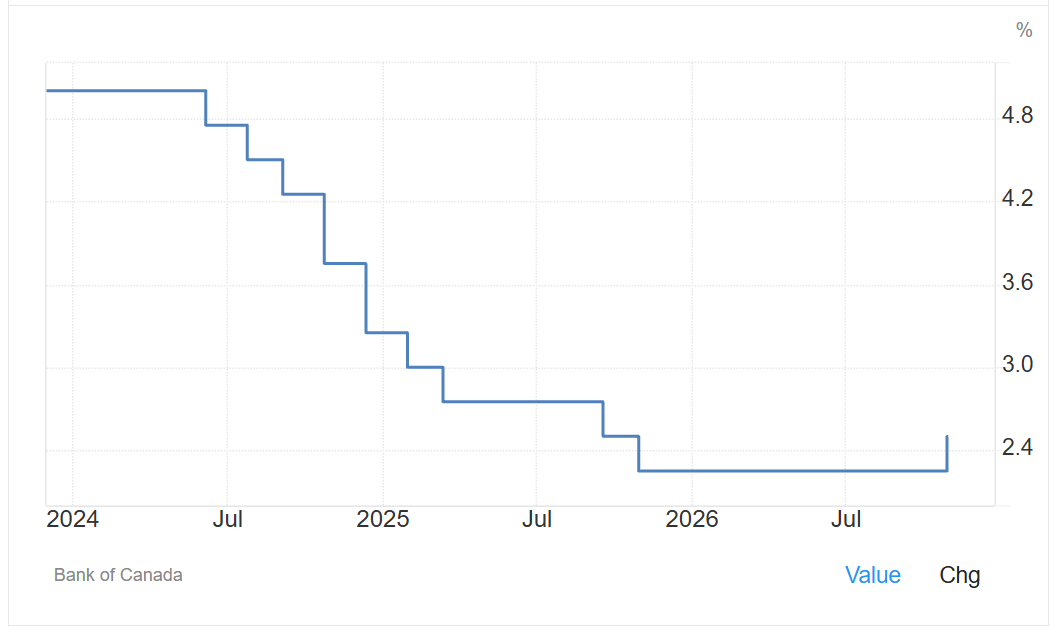
The Bank of Canada hiked the overnight rate by 25 bps to 2.5%.
Bottom Line
The Bank of Canada revised its forecast as follows:
- The central bank issued a revised forecast that sees much hotter inflation — 3.5% by the end of this year. Policymakers don’t expect to hit their 2% target until mid-2028.
- “The main argument for an increase was that energy prices are higher, they are expected to remain higher, and cost pressures are building,” Governor Tiff Macklem said in prepared remarks.
- Economic growth is looking much stronger. Officials raised the outlook and now expect the economy to expand 1% in 2026, accelerating to 2% in 2027 and 2028.
Macklem says the BOC highlighted inflation since September and emphasized the high level of uncertainty in the Middle East and in Canada/US relations, as well as how quickly those events pass through to the economy. He says there’s no predetermined path and repeated that they’ll make decisions one meeting at a time.
Macklem says changing direction is a difficult decision, and you want to look at it through more than one lens. One lens is the economic projection in the monetary policy report, which shows inflation is higher and will stay higher for longer. He says the implication is pretty clear — there’s less scope for accommodation. Against that backdrop, the governing council agreed an interest rate increase made sense. But he adds that forecasts are highly uncertain.
In the last several months, Macklem says the balance of risks has shifted: Inflation is looking less likely to be contained. Today’s rate increase looks more like an “insurance policy” rather than the beginning of a series of rate hikes. The decision rests on stronger economic growth ahead, and that assumption will be tested, especially as the labour market still shows signs of slack. The Bank’s room to raise rates further is limited. Financial conditions have already tightened, and while higher interest rates cannot fix a supply disruption, they can further weaken demand.
Central banks tend to start their rate cycle with consecutive moves. It would require weakening economic activity or slower inflation than expected. With that in mind, we think the BOC will hike again in December. However, this is more about bringing forward hikes we had expected in early 2027.
The communications make it clear that the central bank wants to stay ahead of the curve and “avoid the debacle” of 2022-23, when it was too late to raise the policy rate, he added.