Articles
Posted on October 19, 2026
Canadian CPI Inflation Edges Up to 3.1% As Core Measures Ease
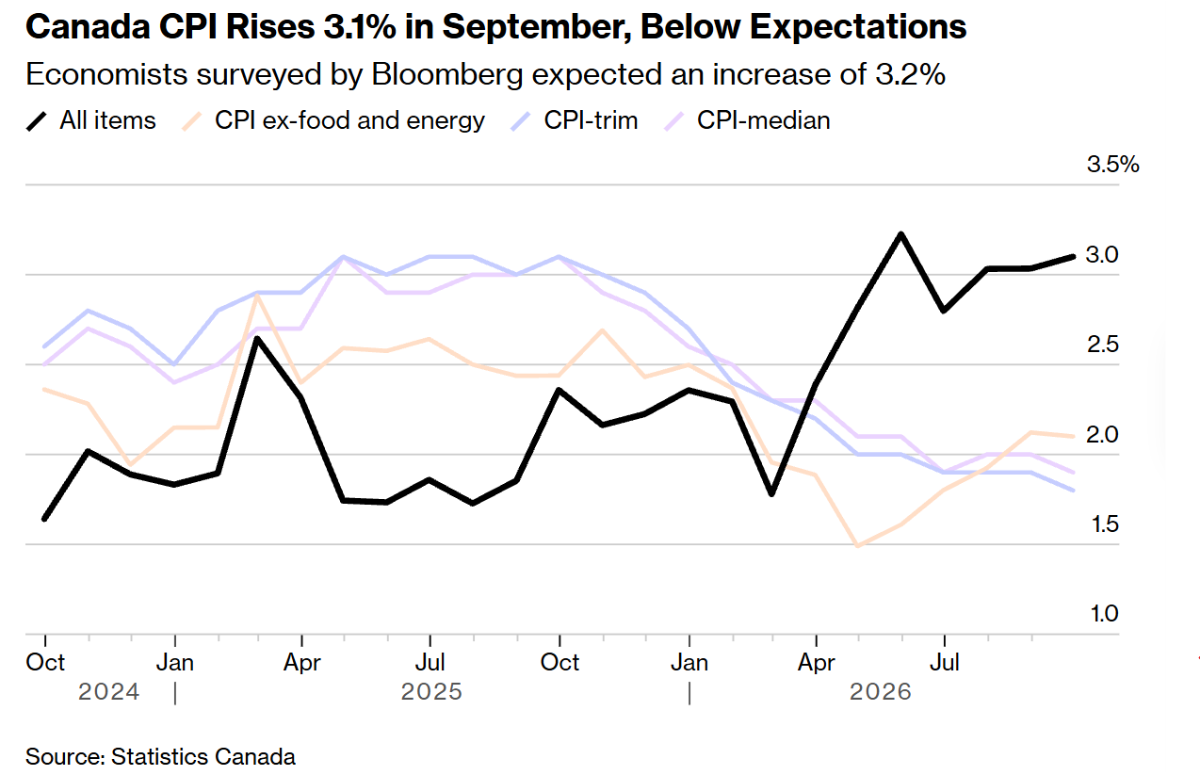
Canadian CPI Inflation Edges Up to 3.1% in September, While Core Inflation Slowed Further Below Its 2% Target
The Consumer Price Index (CPI) rose 3.1% year over year in September, up from 3.0% in August. Higher gasoline prices led the acceleration in September (+27.8%) compared with August (+22.8%). Excluding gasoline, the CPI rose 2.2%, after increasing 2.4% in August.
Moderating the acceleration in the all-items CPI in September were smaller year-over-year price increases for travel tours and groceries compared with the previous month.
The CPI increased 0.1% month over month in September. Seasonally adjusted, the CPI rose 0.4%.
Energy prices accelerated in September, rising 19.0% year over year after a 15.4% gain in August. Crude oil prices rose in September, reaching their highest level since May amid ongoing uncertainty about the wars in the Middle East, which pushed up gasoline and fuel oil prices.
Year over year, prices for gasoline rose at a faster pace in September (+27.8%) compared with August (+22.8%). The switch to the less expensive winter blend moderated the increase in gasoline prices in September.
Similarly, prices for fuel oil and other fuels rose 57.8% year over year in September, following a 43.7% increase in August. The price increase in September had a greater impact on consumers in Atlantic Canada, where fuel oil is more widely used.
Prices for food purchased from stores rose 1.7% year over year in September, after increasing 2.8% in August. Although price levels remain high, this was the smallest yearly increase since May 2024 (+1.5%), and the second consecutive month where grocery price growth increased at a slower pace than the all-items CPI.
Driving the year-over-year slowdown in grocery prices in September 2026 were declines in prices for fresh vegetables (-2.9%) and sugar and confectionery (-2.7%). Prices for other food preparations (+1.8%) and fresh or frozen beef (+8.7%) rose at a slower pace in September than in August (+2.8% and +11.0%, respectively), also contributing to the slowdown.
Despite the year-over-year slowdown in grocery prices, prices have increased 33.0% since September 2020.
In September, shelter prices rose 1.8% year over year, up from a 1.5% increase in August. In addition to higher prices for fuel oil and other fuels (+57.8%), faster price growth in homeowners’ home and mortgage insurance (+4.9%) and homeowners’ maintenance and repairs (+1.2%) drove the acceleration.
The homeowners’ replacement cost (-1.9%) and mortgage interest cost (-0.2%) indexes fell at the same rate in September as they did in August. Meanwhile, rent prices rose 2.8% year over year, matching the August increase.
In addition to the slowdown in core measures, the share of CPI components rising at 3% or higher fell to 29.2% from 34.2% in August.
Year over year, prices rose faster in five provinces in September than in August, mainly because of higher prices for gasoline and fuel oil.
Excluding energy, inflation was higher in Nova Scotia (+3.3%), Prince Edward Island (+2.6%), New Brunswick (+2.6%), and Newfoundland and Labrador (+2.4%) in September, compared with the national movement (+2.1%). At the provincial level and on a year-over-year basis, rent prices rose at the fastest pace in Atlantic Canada.
Economists surveyed by Bloomberg had expected the headline inflation rate to tick up to 3.2% in September from 3% in August, and yearly change for the Bank of Canada’s preferred core measures to remain the same.
The Canadian dollar trimmed its gains after the report. It still remained stronger on the day against the US currency, trading 0.3% up to C$1.4101. The loonie has advanced about 1% so far in October.
Traders in overnight swaps placed the odds of a rate hike this month at nearly 70% prior to the CPI release, and edged back slightly after the smaller-than-expected increase in price growth.
Bottom Line
Today’s inflation report reinforces our view that higher gasoline prices temporarily boost headline inflation while further eroding household purchasing power. However, these energy-driven increases, largely tied to geopolitical tensions, are unlikely to trigger a broader resurgence in underlying inflation. While food and shelter continue to account for a disproportionate share of price growth, inflationary pressures across the economy are generally moderating amid slowing domestic demand.
At the same time, recent labour force data has underscored some of the economic vulnerabilities facing Canada as the US trade war drags on. Employment fell in Canada by 41, 200 since the end of last year, the largest year-to-date loss since the 2009 financial crisis, excluding 2020 during the Covid-19 pandemic
The duration of the disruption in the Strait of Hormuz remains a key risk. The longer the shipping route remains closed, the longer energy prices are likely to remain elevated. Even so, the September data support our base-case scenario that the Bank of Canada will remain on hold at its October 28 meeting. Policymakers will continue to closely monitor incoming inflation data and stand ready to tighten policy if price pressures broaden and become more persistent. Still, for now, underlying inflation trends in Canada remain consistent with a patient, wait-and-see approach.