Articles
Posted on October 9, 2026
Another Weak Canadian Labour Report will Temper the BoC’s Rate Hike Fervour
The Very Weak September Jobs Report For Canada Will Give the BoC Second Thoughts About Hiking Rates
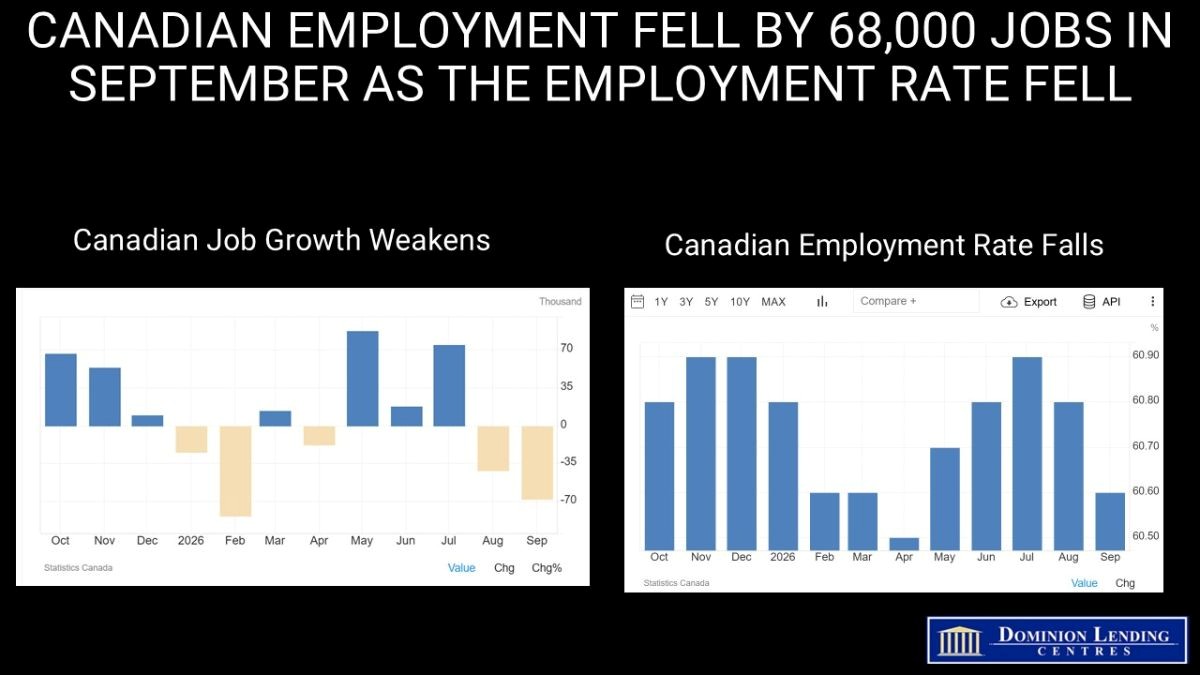
Employment fell in September, continuing a stream of lacklustre labour force surveys. Canadian jobs fell by 68,300, wiping out all of this year’s job gains as the trade war with the U.S. drags on and the Iran war continues. The employment rate fell for a second consecutive time by 0.2% percentage points to 60.6%. Roughly half of the employment loss was in full-time work (-35,000; -0.2%) and part-time work (-33,000; +0.9%).
The employment decline was concentrated among youth aged 15 to 24 (-48,000; -1.8%) as well as women aged 25 to 54 (-28,000; -0.4%). In September, public sector employment fell by 70,000. This was the fourth consecutive monthly decline for the sector. On a year-over-year basis, the number of public sector employees was down by 119,000 (-2.6%), with most of the decline attributable to employment in educational services.
The number of private sector employees was little changed for a second consecutive month in September, but it was up by 163,000 (+1.2%) compared with 12 months earlier. Self-employment edged down in September (-23,000; -0.8%). This follows an upward trend from April to July. Year on year, self-employment was up by 51,000 (+1.9%).
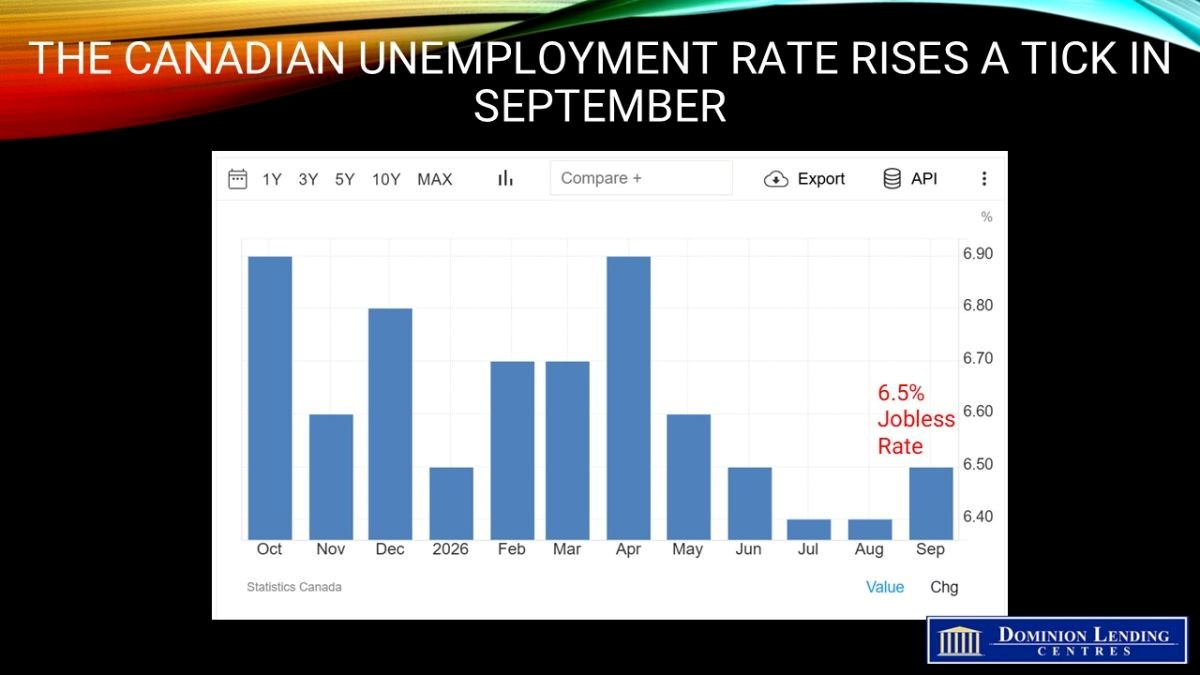
The unemployment rate rose 0.1 percentage points to 6.5% in September. Earlier in the year, it reached a recent peak of 6.9% in April, before declining to 6.4% in July and August. The unemployment rate in September was the same as it was at the start of the year (6.5% in January).
The layoff rate—representing the proportion of people who were employed in August but had become unemployed in September as a result of a layoff—was 0.7%, similar to the rate observed a year earlier (0.6%) and the average during the period from 2017 to 2019 (0.6%) (not seasonally adjusted).
The job-finding rate was 30.6% in September, down from 32.8% 12 months earlier and below the average of 36.5% during the period from 2017 to 2019. This refers to the proportion of people who were unemployed in August and had found a job in September.
The labour force participation rate—the proportion of the population aged 15 and older who were employed or looking for work—fell 0.2 percentage points to 64.8% in September. This was the lowest level since December 1997 (when it was also 64.8%), excluding 2020 during the COVID-19 pandemic. Year over year, the participation rate fell 0.4 percentage points in September 2026, largely due to population aging.
While older Canadians are participating in the labour market at higher rates relative to previous cohorts, there is nonetheless a drop-off in participation rates at older ages, especially for those aged 65 and older.
In September 2026, people aged 65 and older accounted for 23.2% of the working-age population (i.e., those aged 15 and older) in the Labour Force Survey, up from 20.5% in September 2019, prior to the COVID-19 pandemic. In comparison, this share was 14.8% at the turn of the millennium.
The upward trend in the share of people aged 65 and older in the working-age population was briefly paused in 2023 and 2024, as sharp increases in permanent and temporary immigration offset the aging of the population. However, in 2025 and into 2026, the trend towards an aging population resumed. The lower labour force participation rate observed in September 2026, relative to a year earlier and to the pre-pandemic period, can largely be attributed to population aging. Using a method that holds constant the September 2019 age composition of the population, the participation rate in September 2026 would be little changed (-0.1 percentage points) year over year and would be 0.2 percentage points higher than in September 2019.
By sector, fewer people worked in educational services, Health care and social assistance, and manufacturing. Regionally, employment declines were posted in Quebec and British Columbia, while energy-heavy Alberta enjoyed continuing job gains. Alberta’s unemployment rate was 6.4% in September, down both month-over-month (-0.4 percentage points) and year-over-year (-1.3 percentage points).
The unemployment rate dipped again to 6.4%, down from 6.5% in June. This represents a two-year low in joblessness, down from the recent peak of 7.1% in September. The unemployment rate has fallen by half a percentage point since the spring. The Bank of Canada will see this as further tightening in the job market.
Among the three largest census metropolitan areas, the unemployment rate rose by 0.7 percentage points to 6.6% in Montréal, offsetting a similar-sized decline in the previous month. In Vancouver, the unemployment rate fell 0.6 percentage points to 6.0% in July. The unemployment rate in Toronto was little changed at 6.7%; however, it was down from a recent high of 9.0% in July 2025.
Bonds rallied, with the two-year Canadian government note yield falling 4 basis points on the day to 3.203%. The Canadian dollar tumbled as low as C$1.4299 per US dollar, the lowest since April 2025, before paring those losses to trade at C$1.4276, down 0.3%, shortly after 9 a.m. New York time.
Economists surveyed by Bloomberg had expected the economy to add a modest 10,000 jobs and the unemployment rate to tick up to 6.5%.
While the job losses last month were driven by the public sector, the cumulative decline in employment since the start of the year paints a sluggish picture of the labour market. Employment fell in Canada by 41,200 since December 2025, the largest year-to-date loss since the 2009 financial crisis, excluding 2020 during the Covid-19 pandemic.
The September data also gives the first look at the impact of so-called Section 338 tariffs on the Canadian economy. New 50% US tariffs on $20 billion of Canadian goods took effect on Aug. 22 after the breakdown in trade negotiations between the two countries, while retaliatory tariffs on US goods kicked in on Sept. 8. Job losses in August and September total 110,000. The trade war escalation is expected to weigh on the economy, but the Bank of Canada has put more emphasis on inflation risks, as the Iran war continues to drive up energy prices.
Bottom Line
The Bank of Canada will likely hold off on a rate hike at its October 28 meeting, especially if the inflation data released on October 19 brings no nasty surprises. The Bank of Canada will also publish its Business and Consumer Outlook Survey that day, which will estimate inflation expectations.
Longer-term interest rates have already risen sharply in recent weeks, largely reflecting enormous borrowing pressure by the U.S. Treasury and the private sector, much of which is AI-related. The U.S. economy has been boosted meaningfully by AI-related capital spending. Business investment in high technology has also picked up in Canada, but to a much lesser extent.
U.S. Treasury borrowing reflects the burgeoning federal budget deficit, now 6% of U.S. GDP. All government debt to GDP is now just over 120% in the U.S. compared to 111% in Canada. Interest on federal debt alone absorbs 35.4% of all federal income-tax revenues stateside. A similar calculation for Canada is only 12.9%. So the U.S. fiscal position is triggering the rise in term risk premia in the U.S. bond market.
Although Canadian bond yields are more than 100 basis points lower than in the U.S. for good reason, our yields typically move in the same direction as U.S. yields. Currently, U.S. housing is hurting, with the 30-year fixed mortgage rate hovering around 7.5%.