Articles
Posted on September 4, 2026
Weak Labour Market Survey for August Take BoC Rate Hike Off the Table.
Weak August Jobs Report In Canada Takes BoC Tightening Off The Table–The Opposite Is Likely For Federal Reserve
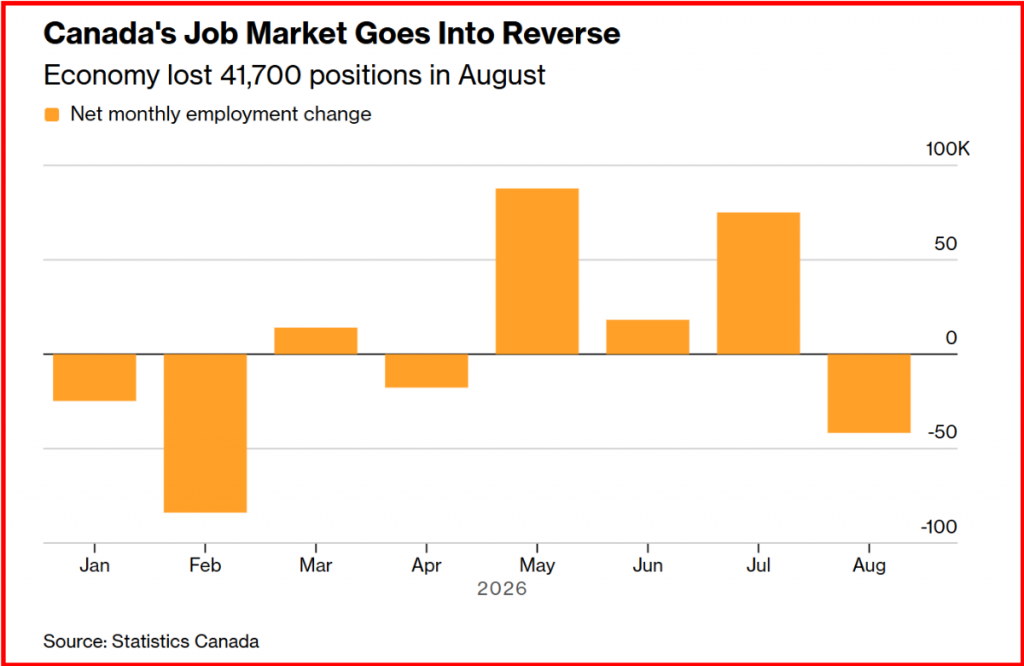
Employment in Canada fell by 41,700 in August, reversing some of the labour market momentum seen in recent months as the manufacturing sector posted the only significant increase. The employment rate fell 0.1 percentage points to 60.8%. The employment rate in August was on par with the rate recorded at the start of the year, and up 0.3 percentage points compared with August 2025.
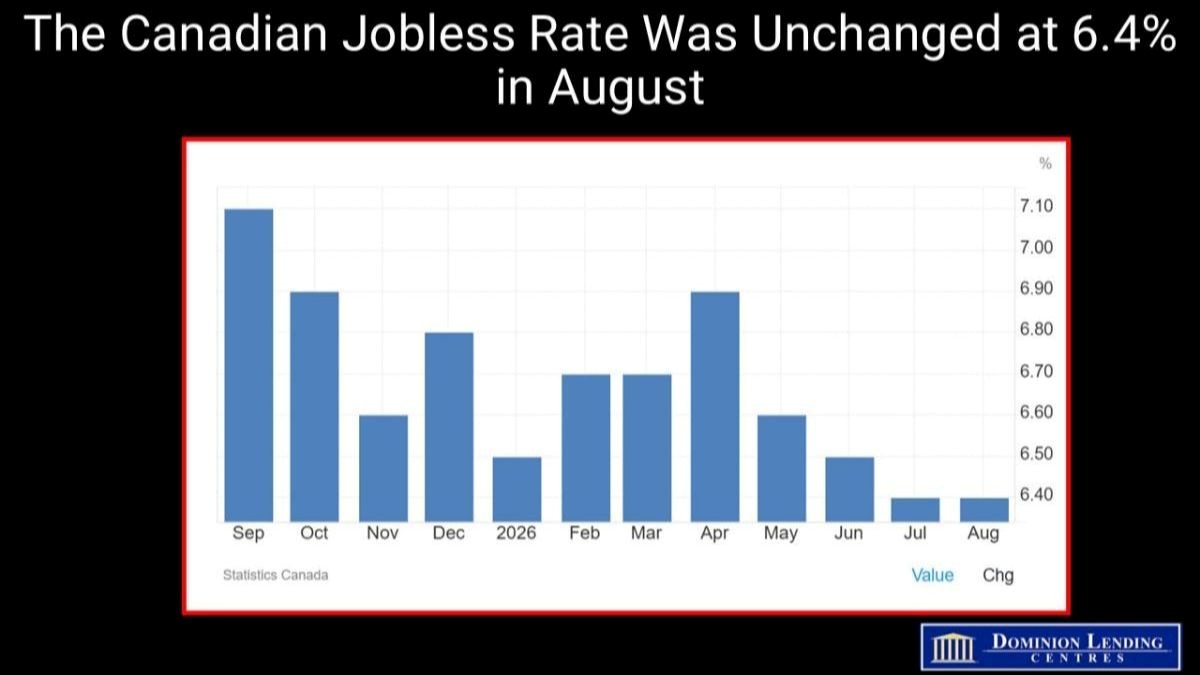
The jobless rate held steady at 6.4% while employment losses were concentrated in Ontario and Quebec, Statistics Canada reported on Friday.
Employment fell among youth aged 15 to 24 (-19,000; -0.7%) and edged down (-16,000; -0.1%) among people in the core-age (25 to 54 years old).
While the overall unemployment rate was unchanged in August, it increased among core-aged men (+0.2 percentage points to 6.0%) and fell for core-aged women (-0.2 percentage points to 5.0%). The unemployment rate was little changed for youth (12.9%) and people aged 55 and older (5.1%).
Employment declined in business, building and other support services (-20,000; -2.8%), public administration (-8,800; -0.7%), natural resources (-7,700; -2.3%) and utilities (-5,600; -3.5%), while it increased in manufacturing (+22,000; +1.2%).
Employment declined in Quebec (-19,000; -0.4%) and edged down in Ontario (-18,000; -0.2%), the two provinces hardest hit by US tariffs. Employment increased in New Brunswick (+2,400; +0.6%) and was little changed in the other provinces.
Average hourly wages among employees were up 2.0% (+$0.71 to $37.02) on a year-over-year basis in August, following growth of 2.8% in July (not seasonally adjusted).
The unemployment rate was unchanged at 6.4% in August. This follows three consecutive monthly declines in May, June and July totalling 0.5 percentage points.
Among the 1.5 million people who were unemployed in August, 24.0% were in long-term unemployment, meaning they had been continuously searching for work for 27 weeks or more. This proportion was similar to that of August 2025 (23.0%) and remained above the pre-COVID-19 pandemic average of 17.1% recorded from 2017 to 2019.
The layoff rate was 0.8% in August, slightly below the rate of 1.0% observed 12 months earlier and similar to the average layoff rate (0.9%) observed for the corresponding months from 2017 to 2019 (not seasonally adjusted). The layoff rate refers to the proportion of people who became unemployed due to a layoff between July and August.
Industries dependent on U.S. demand for exports continue to face an uncertain economic context, compounded by the recent imposition of new U.S. tariffs on Canadian exports. In the 12 months to August, the layoff rate averaged 0.9% for workers in industries dependent on U.S. demand for exports. In comparison, the rate was 0.7% for other industries over the same period.
The participation rate—the proportion of the population aged 15 and older who were employed or looking for work—fell 0.1 percentage points to 65.0% in August, offsetting a similar-sized increase in July. On a year-over-year basis, the participation rate was little changed.
Employment declined in business, building and other support services (-20,000; -2.8%), public administration (-8,800; -0.7%), natural resources (-7,700; -2.3%), and utilities (-5,600; -3.5%) in August. Despite monthly declines, employment in these four industries was little changed year over year.
Manufacturing (+22,000; +1.2%) was the only sector to record a significant increase in employment in August, with most of that increase (+14,000; +1.7%) in Ontario. Year over year, employment in this sector was largely unchanged, as the August increase offset earlier decreases.
Over the 12 months to August, employment growth was concentrated in health care and social assistance (+129,000; +4.5%), information, culture and recreation (+49,000; +5.9%) and transportation and warehousing (+47,000; +4.4%). On the other hand, wholesale and retail trade (-55,000; -1.8%) recorded the largest decline across industries over the same period.
Year-over-year growth in average hourly wages decelerates for the second consecutive month
Average hourly wages among employees in August were up 2.0% (to $37.02) year over year, following growth of 2.8% in July and 3.3% in June (not seasonally adjusted).
Year-over-year growth in average hourly wages remained robust through the post-pandemic period, averaging 4.9% over 2023 and 2024 before decelerating to an average of 3.4% in 2025. Wage growth in August 2026 was the slowest since November 2017 (when it was also 2.0%), excluding the year 2021, during the COVID-19 pandemic.
Year-over-year wage growth was slower for employees with lower wages in August. For employees in the bottom 25% of the wage distribution, average hourly wages were up 1.1% (to $18.66) year over year, while they were up 1.3% (to $26.61) for employees in the second lowest 25% of the wage distribution. In comparison, wages grew faster for employees in the third (+2.1% to $37.99) and top (+2.1% to $65.15) quartiles.
Bottom Line
In a separate release this morning, the U.S. nonfarm payrolls report showed exceptional strength in direct contrast to the Canadian jobs report. The U.S. added 162,000 net new jobs, about triple the consensus estimate. The report included upward revisions for prior months. Wages gained, too, but still trail annualized inflation. The jobless rate held at 4.1%. The labour force participation rate expanded, and the strong report stoked bets on a September Fed interest rate hike when the FOMC meets again on September 15-16.
The Bank of Canada is likely to remain on the sidelines as inflation is weaker in Canada and the economy is vulnerable to a broader slowdown, particularly if the Trump administration introduces even larger tariffs on January 1, as it is currently threatening.