Articles
Posted on May 19, 2026
Canadian CPI Inflation Rises to 2.8% As Core Inflation Measures Decline
Canadian Inflation Rose to 2.8% in April as Core Inflation Approached 2% Target.
Statistics Canada released the April CPI data this morning, showing a smaller-than-expected rise in headline inflation. The Consumer Price Index (CPI) increased 2.8% y/y in April, up from 2.4% in March.
Higher energy prices, particularly gasoline, drove the acceleration. In April, energy prices rose 19.2%, following a 3.9% gain in March. Gasoline prices continued to rise year over year in April, increasing sharply by 28.6% after a 5.9% gain a month earlier.
The removal of the consumer carbon levy on April 1, 2025, led to a monthly price decline that month, putting upward pressure on year-over-year gasoline price movement in April 2026. In addition to the accelerating base-year effect, prices were pushed higher by supply uncertainty (caused by the conflict in the Middle East) and by the switch to the more expensive summer blend. The temporary suspension of the federal fuel excise tax, which took effect on April 20, moderated the increase.
Similarly, prices for fuel oil and other fuels increased 41.3% year over year in April, amid higher oil prices linked to the conflict in the Middle East.
A smaller year-over-year decline in natural gas prices in April (-2.4%) compared with March (-18.1%) also exerted upward pressure on energy prices. Natural gas prices were impacted by the removal of the consumer carbon levy in April 2025.
Moderating faster price growth in the all-items CPI was a year-over-year decline in prices for travel tours and a slowdown in rent prices. The CPI was up 0.4% month-over-month in April. On a seasonally adjusted monthly basis, the CPI increased 0.3%.
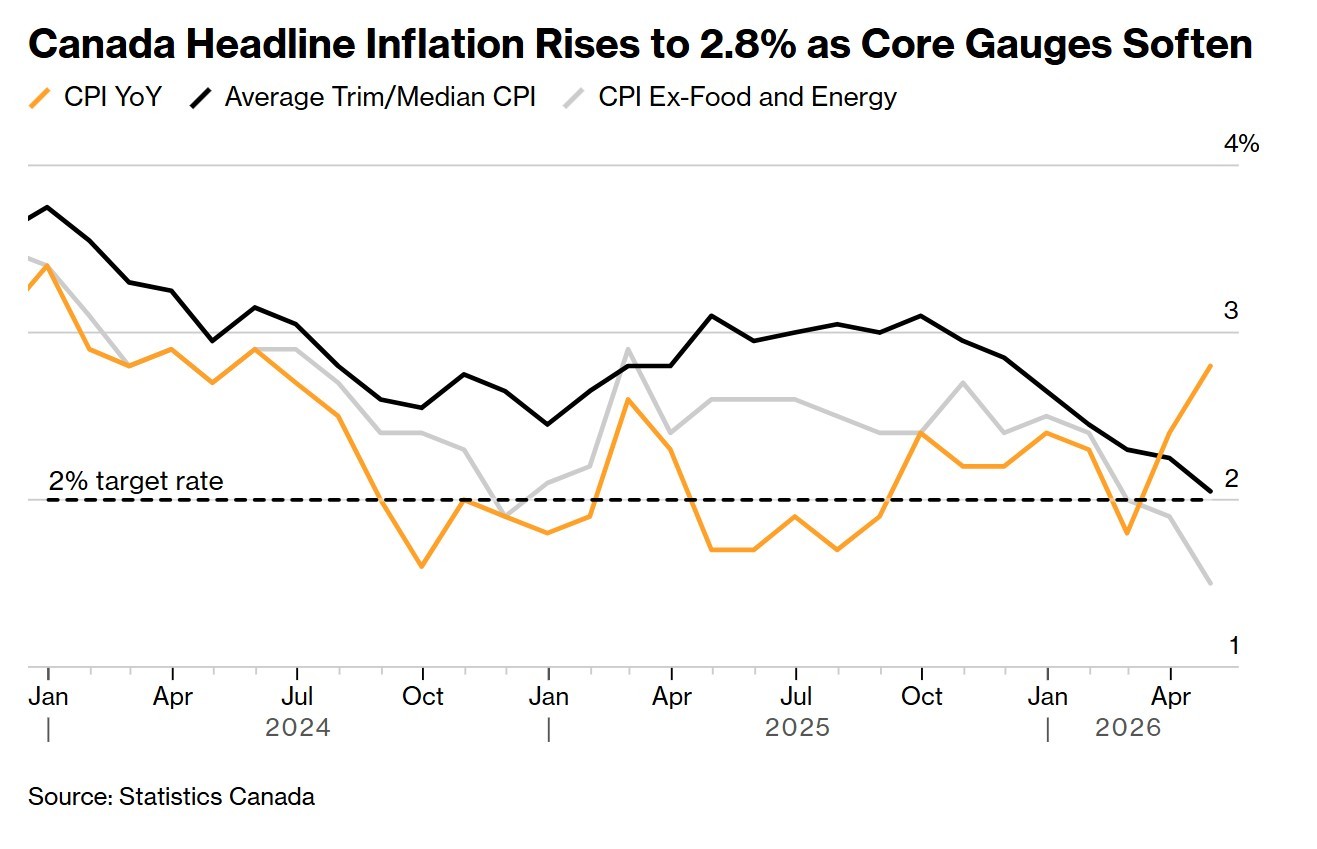
Core measures of inflation, which strip out volatility in price movements, suggest that pressures have softened outside of energy. The Bank of Canada’s preferred core gauges decelerated last month, with the average of the trim and median metrics at 2.05%, the lowest it’s been since January 2021. Inflation excluding food and energy also fell to 1.5%, the lowest level since March 2021.
The CPI Trimmed-mean in Canada, which is a measure of core inflation, decreased to 2.0% in April 2026 from 2.2% in the previous month, missing market expectations of 2.1%. CPI Trimmed-Mean in Canada averaged 2.10 Percent from 1990 until 2026, reaching an all-time high of 5.70% in June of 2022 and a record low of 0.80% in November of 1997.
The CPI-Median in Canada, which is a measure of core inflation, decreased to 2.1% in April 2026 from 2.3% in the previous month, missing market expectations of 2.2%. CPI Median in Canada averaged 2.15 Percent from 1990 until 2026, reaching an all-time high of 5.40% in October of 2022 and a record low of 0.90% in November of 1997.
Bottom Line
Today’s report is consistent with our view that higher gasoline prices will lift headline inflation and reduce household purchasing power. Still, these war-related pressures are unlikely to reignite systemic inflation pressures. While some categories, especially food and shelter, continue to contribute disproportionately to inflation, broader price pressures are easing alongside soft labour market conditions.
The longer the Strait of Hormuz remains closed, the longer energy prices will remain elevated; overall, the April data support our base case that the Bank of Canada will remain on the sidelines for the rest of 2026. The Bank will continue to monitor price data carefully, promising rate hikes if inflation ticks up and appears entrenched.